F&B is the single largest discretionary line item in most corporate event budgets — and the single category most likely to drive negative attendee survey feedback when it’s wrong. Per BizBash’s annual industry cost surveys, corporate event F&B costs have climbed meaningfully since 2022, which has tightened the math on what’s worth investing in and what isn’t. This guide is the working catering-trends list we use with corporate event clients in 2026–2027.
What’s covered: what’s actually changed in the past 2–3 years, what we recommend planning for, and where the cost pressure is highest.
The Post-2022 Cost Reality
Before getting to specific trends: a baseline on the cost math. Per the latest BizBash industry data, the average per-attendee F&B cost at corporate events has climbed roughly 15–25% above 2019 baselines, driven by labor, ingredient inflation, and venue minimum increases. The implication: the same F&B program you ran in 2019 costs meaningfully more in 2027, and the cheap-out moves (cutting the breakfast spread, dropping the afternoon snack) consistently come back as low scores on the post-event attendee survey.
The practical reframe: F&B is no longer a residual budget line item to be optimized down. It’s a deliberate program component that needs explicit budget defense and conscious design. The trends below all assume that reframe.
Trend 1 — Dietary Inclusivity as the Default, Not as Opt-In
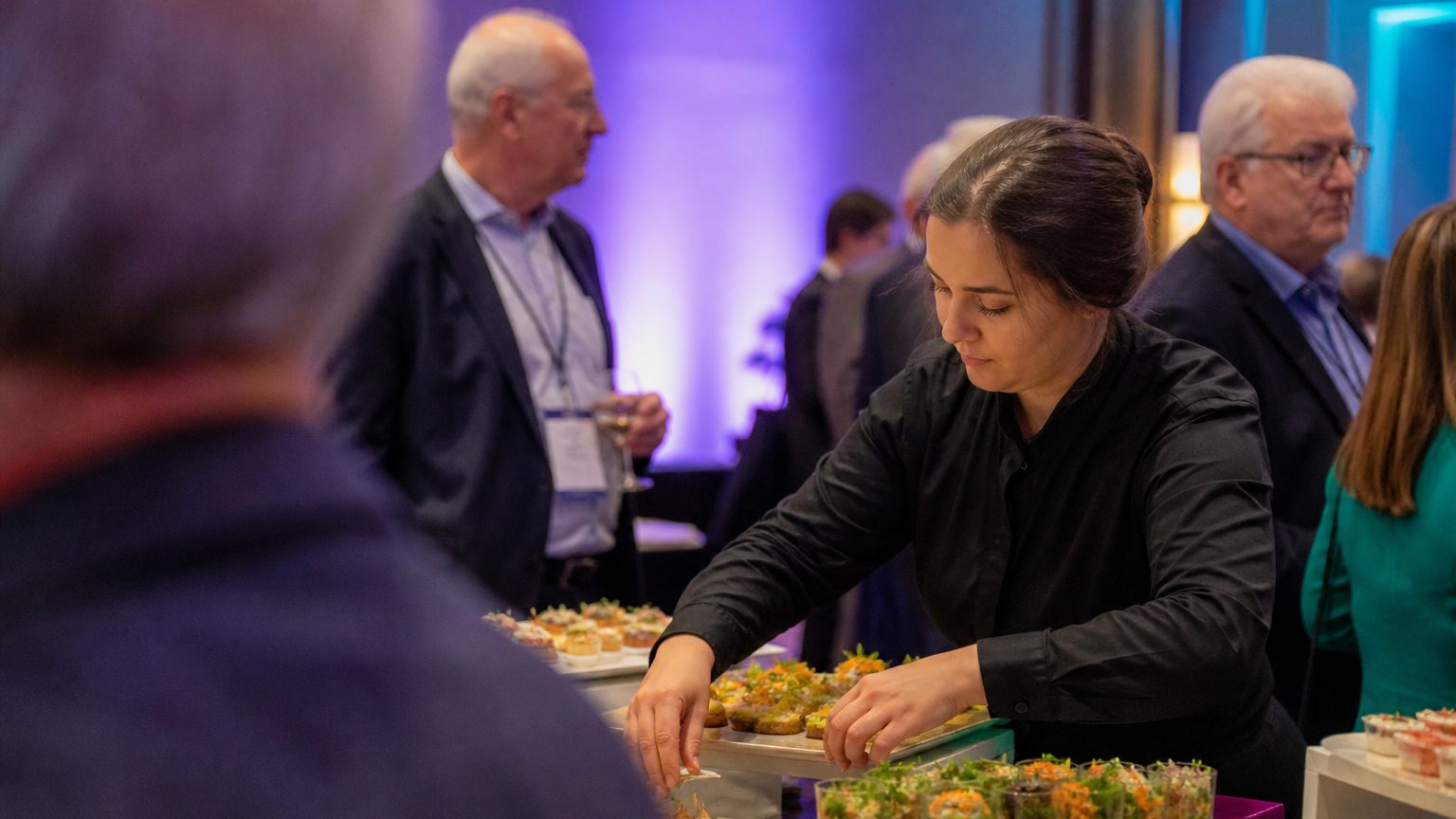
The dietary-restriction landscape has expanded materially since 2019. The 2019 default of “regular menu + vegetarian option + we’ll handle requests” is no longer competent for most corporate event audiences. The 2026–2027 default that’s working:
Menu design starts with a base that’s vegetarian, vegan-adjacent, and gluten-free-friendly — with meat and seafood additions for the audience that wants them. This is the inverse of the historical approach (meat-default with vegetarian “option”). Per Catersource industry coverage, this menu architecture consistently rates higher on attendee satisfaction across mixed-dietary audiences without meaningfully higher cost than meat-default menus.
The other practical shift: dietary preferences are now collected at registration time (not on a paper card at check-in), and the catering team gets the breakdown 5–7 days out — enough time to actually plan, not enough time for it to drift from final headcounts.
Trend 2 — Local Sourcing as Procurement Default
“Locally sourced” has shifted from a marketing line to a procurement-policy default. Per PCMA Convene industry coverage, most enterprise corporate event catering contracts now include local-sourcing language as standard, and the supplier infrastructure has scaled to support it without the cost premium that existed in 2018.
The practical version of “local”: ingredients sourced within a defined regional radius (often 100–150 miles of the venue), with named producer credits on the menu. The named-producer credit (“Bay scallops from Wellfleet, MA,” “Beef from Sweet Grass Farm, Spring Hill, TN”) consistently rates well on attendee experience and turns the F&B into a destination-marketing moment.
The cost reality: the local-sourcing premium versus generic banquet menus has compressed to 5–10% as suppliers have built scaled regional networks. For most programs, this is now defensible budget given the attendee-experience impact.
Trend 3 — Plated Dinners Are Back (Vs. Buffet/Station)
The 2018–2022 era of “stations everywhere” — buffet-style with multiple action stations — has been moving back toward plated dinners for the program’s anchor dinner moments. Per Successful Meetings industry coverage, plated dinners consistently rate higher on perceived quality and on attendee experience for the program’s flagship evening.
The math: plated dinners have higher per-cover labor cost but lower waste and lower per-cover ingredient cost than action-station catering. For most enterprise programs at scale (300+ attendees), the total cost difference is smaller than most planners assume. The experience difference — being served a coursed meal vs queuing at stations — is meaningfully larger.
The exception: morning meals and informal mid-program meals are still better as stations or buffet. The plated format works for the program’s deliberate “this is a moment” meals — opening night dinner, awards dinner, closing celebration.
Trend 4 — Coffee & Late-Night Programming as Deliberate Anchors
Two adjacent F&B moments have moved from afterthought to deliberate program component:
Coffee programming. The “morning coffee and bagels” default has become a meaningful element of the program’s day-1 energy. Specialty coffee programming (named local roaster, barista service, pour-over options) consistently rates well in attendee surveys and runs $4–$8 per attendee above default coffee service.
Late-night programming. The post-9pm window — once “everyone is at the hotel bar” — is now an explicit programming opportunity. Late-night dessert lounges, named-cocktail bars with curated music, hospitality suite programming. The attendees who participate in late-night programming consistently rate the overall program meaningfully higher than attendees who don’t. Per Event Marketer industry coverage, this is one of the most under-invested categories relative to the experience impact.
Trend 5 — Alcohol-Conscious Programming
The most-changed-since-2019 trend on this list. The default of “open bar from 6pm” is being replaced by more deliberate alcohol programming:
Per BizBash and Catersource industry coverage, the share of corporate event attendees electing alcohol-free options has grown materially since 2020. The catering response: more sophisticated mocktail programs (not “Shirley Temple as afterthought” but actual curated zero-proof cocktail menus), restructured bar service (signature cocktails rather than full open bar), and earlier-ending alcohol service for evening programs.
The cost implication is favorable for program budgets — mocktail-heavy and signature-cocktail-focused programs run meaningfully cheaper than traditional open bar at scale, while consistently rating better in attendee surveys on the “responsible programming” dimension.
What’s Not Worth Investing In
Three F&B trends that get coverage but haven’t held up in attendee experience scoring:
“Molecular gastronomy” / theatrical food presentations. The novelty wore off. Attendees rate quality higher than spectacle.
Food-truck “real” experiences at corporate events. The logistics of food-truck programming at corporate venues consistently underperform the experience promise. Use the format only when the program is genuinely outdoor.
“Healthy” replacement programs that swap quality for calorie counting. Attendees notice. The wellness-anchored approach (real food, smaller portions, better-quality ingredients) consistently beats the calorie-optimized approach.
The Budget Math
For a 3-day corporate program of 300 attendees with morning + lunch + 2 receptions + 1 plated dinner, the working per-attendee F&B budget for 2027:
Floor (defensible base): $185 per attendee per day, or about $555 across the 3 days.
Default (most-booked tier): $250 per attendee per day, or about $750 across the 3 days.
Premium (event-as-experience tier): $325 per attendee per day, or about $975 across the 3 days.
These ranges include service, gratuity, and venue F&B minimums. Costs run 15–25% higher at major coastal cities (NYC, SF, Boston) versus second-tier markets.
If you want help building an F&B program for your next corporate event that ties to your specific budget and attendee profile, our team can help. We work with the catering teams at most of the property tiers named throughout this guide and can typically save 5–10% off venue F&B minimums on the negotiation side.
Related reading: How to host successful in-person events in 2027 — the operations companion to this F&B trend guide.
Related reading: 2027 President’s Club destination guide — for the top-performer reward category where F&B quality matters most.
Related reading: Choosing the Perfect Event Menu and How Event Planners Can Host Inclusive Meetings.