Most posts about corporate event planning in Los Angeles read like brochures. Ours is going to read like a checklist, because that’s what LA actually demands. This city rewards planners who treat it as a logistics problem first and a vibes problem second. The vibes take care of themselves once the shuttle manifest, the IATSE call sheet, and the FilmLA permit are locked.
We have built programs across DTLA hotels, Culver City soundstages, Santa Monica rooftops, and the occasional Malibu private estate that made everyone’s Instagram and nobody’s shuttle schedule. The failure modes in LA are not glamorous. They are traffic, union labor pass-throughs, fire marshal caps, and the phrase “we assumed the venue handled that.”
What follows is the buyer’s guide the incumbents refuse to write: neighborhood context, real ranges instead of dollar theater, the union and permit landscape, a planning timeline by event size, and a vetting framework you can drop into an RFP tomorrow.
Why Los Angeles is harder than it looks
LA is not one market. It is roughly eight sub-markets stitched together by freeway, each with its own venue inventory, labor rules, and transit reality. A 300-person leadership offsite in Santa Monica and a 300-person product launch in DTLA are two different programs with two different budgets, two different production crews, and two different attendee experiences. Treat them as such.
The city hosts a serious volume of meetings and incentive programs — LA Tourism & Convention Board tracks tens of millions of visitors annually, and the meetings segment is a real slice of that. What the market data does not tell you is that LA’s venue supply skews toward two extremes: purpose-built convention product (LACC, JW Marriott L.A. LIVE) and non-traditional spaces (soundstages, museums, rooftops, private estates) that require you to bring the event with you. The middle — flexible hotel ballrooms with strong in-house production — is thinner than you’d think, which is why lead times matter more here than in most cities.
LA venues by neighborhood and use case
Neighborhood choice drives your production budget, your attendee experience, and your risk profile more than the venue itself does. Here is how we sort them.
Downtown LA (DTLA) — conferences and general sessions
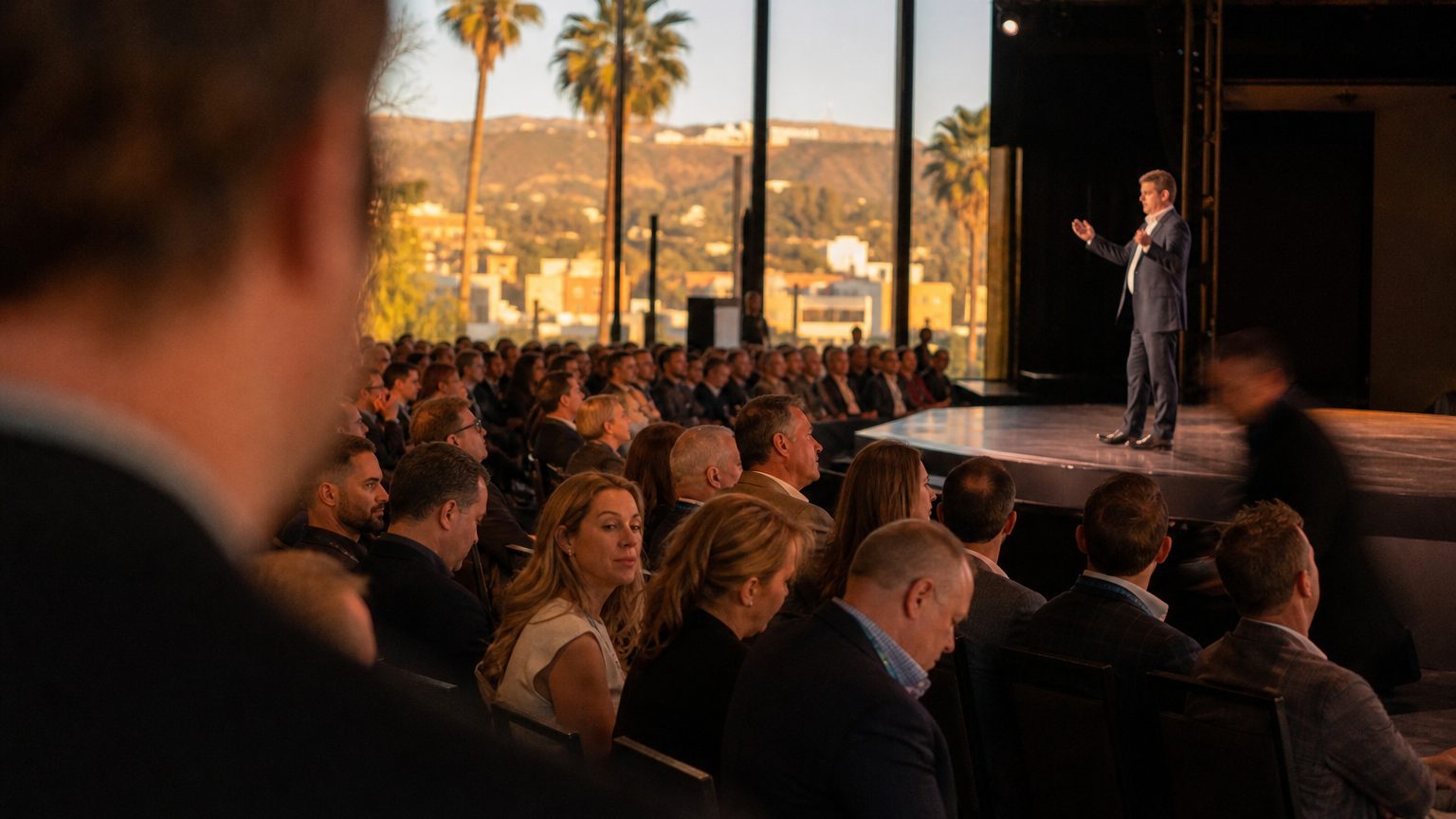
DTLA is the default for anything over 400 attendees with a general session component. The Los Angeles Convention Center, JW Marriott L.A. LIVE, Intercontinental Downtown, and The Majestic Downtown cluster gives you connected room blocks, real ballrooms, and walkable F&B. Trade-off: LACC is a union house, and you will pay for IATSE stagehands whether your in-house AV partner mentions it in the first quote or not.
Santa Monica and Venice — creative offsites and executive retreats
Santa Monica Proper, Fairmont Miramar, Shutters on the Beach, and the boutique inventory around Abbot Kinney work for leadership offsites in the 40-150 range. The light is better, the food is better, and the attendee NPS is measurably higher. Trade-off: room blocks are smaller, F&B minimums per function space are higher relative to headcount, and parking is a real design constraint.
Culver City and the Westside — tech launches and product events
Sony Pictures Studios, Culver Studios, and the Amazon/Apple-adjacent Westside venues are where product launches, developer conferences, and film-adjacent activations land. Soundstages give you a blank box with real power and rigging, which sounds appealing until you price the buildout. Everything — walls, HVAC, load-in floor — is a line item.
Hollywood and West Hollywood — premieres, brand activations, awards adjacencies
NeueHouse Hollywood, The Hollywood Roosevelt, Goya Studios, and the rooftop inventory along Sunset are built for brand activations and press-forward events. If your event has a red carpet or a media list, this is your zone. If it does not, you are paying for glamour tax you do not need.
Pasadena, Long Beach, Beverly Hills — the honorable mentions
Pasadena (Langham Huntington, Pasadena Convention Center) is quietly one of the best mid-size conference markets in the region and gets ignored because it isn’t “LA” to out-of-town attendees. Long Beach works for auto and manufacturing verticals with convention needs. Beverly Hills is where you host boards and top-tier client dinners, not general sessions.

What LA corporate events actually cost (ranges, not rate cards)
We are not going to publish a rate card, because your program’s number depends on headcount, venue tier, production scope, and season. What we can do is describe the ranges honestly.
A 50-person executive dinner in Beverly Hills sits in a different universe than a 500-person conference at LACC with a custom general session set. Between them: a 200-person sales kickoff in DTLA with two general sessions, three breakouts, an offsite dine-around, and one big closing party. Each of those three programs has a mid-market version and a premium version, and the delta between them is roughly 2-3x on total spend once you include AV, F&B, ground transportation, and staffing.
The line items that surprise first-time LA buyers: IATSE labor at union houses (often 20-30% of your AV bill once you count call minimums and meal penalties), FilmLA permits for anything touching a public street or a rooftop with public visibility, and ground transportation for a distributed attendee experience. The F&B minimums at DTLA hotels have come off their peak — Northstar Meetings Group has tracked softening in major-market minimums through 2024 — but they are still meaningful, and Q1 and Q4 remain the tightest windows for negotiation.
For a real number tied to your program, we’re happy to scope it. Talk to our team and we’ll put a range on the table within a week.
The LA-specific stuff nobody warns you about
IATSE and union labor
Most LA convention venues, major hotels, and studio properties are union houses. That means IATSE stagehands handle load-in, rigging, and strike, and the rules around call minimums, meal breaks, and overtime are real. First-time planners get burned when their AV vendor’s quote assumes non-union labor and the venue’s rider does not. Ask two questions in every RFP: is this a union house, and is union labor pass-through included in the AV quote or billed separately.
FilmLA permits and street closures
Anything happening on a public street, a rooftop with public sightlines, or a property that requires traffic control needs a FilmLA permit. Lead time is a minimum of 4-5 business days for straightforward permits and considerably longer for anything involving LAPD traffic officers or LAFD standby. Rooftop activations in particular trip planners up — the venue may say yes, but the permit process is the gate.
Fire marshal caps and LAFD standby
Venue capacity on paper and fire marshal occupancy for your specific setup are two different numbers. Add a stage, a truss, and rear projection, and your usable capacity drops. For any event with pyro, open flame (including sterno at scale), or non-standard rigging, budget for LAFD standby.
June Gloom, wildfire season, and outdoor risk
May and June bring persistent marine layer through mid-morning — beautiful sunset photos, chilly 10am welcomes. September and October are wildfire season, and air quality can turn a rooftop dinner into a health call within 24 hours. Every outdoor event needs a documented weather and air-quality contingency and a real indoor backup, not a tent quote that only exists on paper.
Parking and LADOT
Attendee parking is a real design constraint, especially on the Westside and in Hollywood. Any street-facing loading zone or valet setup that touches a public right-of-way requires LADOT coordination. Build this into the timeline, not the week-of run of show.
Planning timelines by event size
The 18-month lead time advice everyone repeats? Honestly, it depends on the event. Here is what actually holds up in LA.
- 50-person executive dinner or board offsite: 60-90 days is workable if you have flexibility on venue. 120 days is comfortable.
- 150-person leadership offsite (2-3 days, single hotel takeover feel): 5-6 months is the working target. Anything under 4 months means you’re taking whatever room block you can get.
- 300-person sales kickoff or user conference: 6-9 months. Peak Q1 SKO season (January-February) needs to be locked by the prior summer or your DTLA and Santa Monica options thin out fast.
- 500+ person conference with general session production: 9-12 months minimum. Add another 3 months if you need connected room block across two hotels or a specific keynote slot.
Two things compress every timeline: needing a specific hotel (not “a hotel in DTLA”) and needing a specific week (not “sometime in Q2”). Flexibility on either buys back months of runway.
How to vet a corporate event planner in Los Angeles
The agency directory pages will list 50 planners and rank them by whoever paid for placement. Here is the actual vetting framework we would use if we were the buyer.
The RFP should ask
- Three references from programs of similar size and format in LA in the last 24 months. Not “clients we’ve worked with” — specific programs.
- General liability insurance coverage limits (1M-2M is standard; larger programs and studio properties often require more) and whether the planner will name your entity as additional insured.
- How union labor pass-through is billed — inside the production quote, or as a separate reconciliation line.
- The planner’s approach to FilmLA permits and LAFD standby: do they handle it in-house or subcontract, and how is it billed.
- Cancellation and force majeure language, specifically around wildfire, air quality, and public health.
Red flags
- “Award-winning” with no named awards. “Celebrity clients” with no releasable references.
- A production quote with no line item for union labor at a venue you already know is a union house.
- Reluctance to name the specific hotels, DMCs, or transportation providers they’ll use.
- A single point of contact with no named backup for the week of the event.
If you’re comparing LA against other domestic markets for a national program, our Dallas event management team runs the same framework in a very different labor and permit environment, and it’s a useful contrast when you’re stress-testing which city fits your program.
Transportation is the hidden failure point
The venue does not set the stage for everything else in LA. Transportation does. A perfect venue in Malibu with a broken shuttle plan will tank your attendee NPS harder than a middling venue in DTLA with a tight one.
Attendee experience research from the IRF and MPI consistently shows that friction in the arrival and departure experience is the single largest driver of negative program feedback. In LA that means: shuttle capacity sized for actual arrival curves (not a spreadsheet average), staged departures, real-time comms when the 405 does what the 405 does, and a documented plan for the person whose flight lands at 11pm.
Design the transportation plan before you sign the venue contract, not after. If your venue choice makes the transportation math impossible, that is the venue telling you no.
Scoping your 2027 LA program
If you are reading this in the current cycle, you are probably scoping something for 2027. The right sequence: lock the business objective and the headcount, pick the neighborhood before you pick the venue, run a real RFP against three planners with the framework above, and build the transportation and permit plan into the venue decision — not after it.
For multi-day programs with a general session, our conferences and meeting planning team runs this scoping motion with clients across DTLA, the Westside, and Pasadena. We are happy to sit in on a scoping call, walk through the framework against your specific program, and put honest ranges on the table. Get in touch and we’ll pick it up from there.