After a decade of running work retreats, one pattern holds: the ones people still quote a year later had fewer activities, not more. One well-facilitated exercise. A lunch that ran twenty minutes long because nobody wanted to stand up. A debrief that tied the exercise to a real Monday-morning behavior. Everything else on those agendas was decoration.
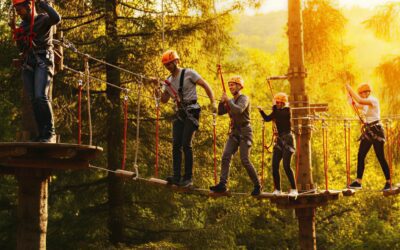
The instinct, when you have forty people in a lodge outside Asheville for two days, is to fill the grid. Nine sessions, a ropes course, a themed dinner, a closing keynote from the CRO. What you get is a group that performs engagement for 48 hours and goes home tired. The behavior change you were actually buying, better conflict handling, faster decisions, new hires who stop lurking silently in Slack threads, does not happen during the ropes course. It happens in the forty minutes after it.
This is the operator version of the question: how to set the ratio, which activities earn agenda time, when to hire a facilitator, what a two-day itinerary looks like hour by hour, and how to tell ninety days later whether any of it stuck. For the wider planning picture, our services overview covers how a retreat fits alongside the rest of a company’s meeting calendar.
The agenda ratio that decides everything else
Most retreat agendas we get sent for review are roughly 80% structured. Ten sessions across two days, with meals treated as logistics rather than programming. That ratio is backwards.
Our working rule: 60% unstructured, 40% structured. Candor needs slack. When every hour is accounted for, people stay in performance mode, and performance mode is exactly the thing a retreat is supposed to interrupt. The research on psychological safety, summarized well in Harvard Business Review’s primer on the concept, keeps landing on the same mechanism: people get honest when the stakes of the moment are low and the relationship is already warm. You cannot schedule that into a 50-minute block.
The hard version of the rule: if your structured activity block exceeds four hours in any single day, you are running a training, not a retreat. Trainings are fine. Call them trainings, write learning objectives, and stop expecting cohesion as a side effect.
What “unstructured” actually means on an agenda
Unstructured does not mean unplanned. It means you designed the conditions and then stayed out of the way. The moves that work:
- Ninety-minute lunches at tables of six to eight, with pre-assigned cross-functional seating for the first meal only. After that, let people choose.
- A free block of at least two hours on day one afternoon. Offer three optional low-commitment things, a hike, a pool, a quiet workroom, instead of one mandatory thing.
- No programmed entertainment at the first dinner. A band in hour four of a retreat is a conversation blocker. Save the music for closing night.
- Fifteen minutes of buffer between every structured session. The hallway conversation is where the session actually lands.
The free block your sponsor will try to fill
Watch out for this one. The open afternoon is the first thing an anxious executive sponsor tries to reclaim, usually eleven days out, usually with a product roadmap review. Get the ratio agreed in writing before you build the grid, because once a session goes on an agenda it never comes off. We have had better luck framing the free block as a deliverable with a name, “cross-team contact time,” than as white space, which reads to a CFO like waste.
What the research actually supports about retreat ROI
There is real data here, and it is not the “team building raises productivity 400%” number that circulates on LinkedIn with no source attached.
Gallup’s Q12 meta-analysis, built on more than 100,000 teams, finds top-quartile engagement teams post 23% higher profitability and meaningfully lower turnover than bottom-quartile teams. A retreat does not move all twelve items. It moves two: item 7, “at work, my opinions seem to count,” and item 10, “I have a best friend at work.” Those are your pre and post measurement targets. The rest of the instrument is a function of management practice between retreats, and no offsite fixes a manager problem.
The IRF 2023 Attendee Preferences Study is the strongest support for the 60/40 split: attendees consistently rate unstructured networking time above structured content when asked what made an experience worthwhile. Group experiences also shape how people judge the company itself, which is why an over-engineered retreat produces cynicism instead of loyalty.
On mechanism, Google’s Project Aristotle studied more than 180 internal teams and found psychological safety outranked skill mix, tenure, and workload as a predictor of team effectiveness. MPI‘s meetings outlook work has tracked the planning-side consequence: in-person gathering budgets for distributed teams have held up because remote-first companies have nothing else that does this job.
Retreats that produce safety produce results. Retreats that produce a photo carousel produce a photo carousel.
Match the activity to the behavior, not to the vibe
Before you pick a single activity, finish this sentence: the behavior we want to be different in ninety days is ___. If you cannot finish it, you are planning a party. Parties are good. Budget and measure them as parties.
- Goal: trust and candor — Symptom: people agree in the room and dissent in DMs · Formats: failure résumé, peer recognition circle · Facilitation: high
- Goal: decision speed — Symptom: every call needs a follow-up call · Formats: live pre-mortem, decision-rights mapping · Facilitation: medium
- Goal: cross-team familiarity — Symptom: handoffs stall between functions · Formats: cooking competition, walk-and-swap pairs · Facilitation: low
- Goal: onboarding a merged or new group — Symptom: two cultures, one org chart · Formats: silent lineup, lightning talks · Facilitation: low
- Goal: recovery after a brutal quarter — Symptom: attendance is up, energy is not · Formats: volunteer build, long unprogrammed afternoon · Facilitation: low
Team building activities for a work retreat that earn their slot
Nine activities, with the metadata a planner needs to self-select, and the debrief question that converts the exercise into something that outlasts the shuttle ride home. The debrief is not optional. An activity without a debrief is recess.
The silent lineup icebreaker, and why it still works
The silent lineup is the one icebreaker we have never retired. The group arranges itself in a single line in a specified order, by tenure at the company, by number of time zones from headquarters, by month of birth, without speaking. No props, no prep, no cost, ten minutes including debrief. It works because it forces non-verbal coordination between people who have only ever interacted in a Zoom grid, and because it ends with a physical artifact: a line that visibly shows who the veterans are and who joined last March.
Run the tenure version if you want the debrief to go somewhere useful. Once the line is set, walk it and have people say their start year out loud. In a 40-person group you will usually see a visible cluster where a hiring surge happened and a thin spot where attrition did. People notice. The prompt we use: “Who in this line knows something about how we used to do things that the rest of us would benefit from hearing?”
What to watch out for: the silent lineup assumes everyone can stand and move for ten minutes and that nobody in the room depends on speech for communication. If you have attendees who are deaf or hard of hearing, the exercise is fine and often better, but brief the facilitator to allow signing. If you have mobility considerations, run the seated variant where people reorder chairs in a semicircle. Also, do not run it after lunch on day two. It is a first-hour tool.
Eight more with group size, duration, and a debrief prompt
- Activity: Failure résumé — Group size: 8-25 · Duration: 60 min · Facilitation: high · Debrief prompt: “What did we actually learn, and what did we quietly stop talking about?”
- Activity: Peer recognition circle — Group size: 6-16 · Duration: 45 min · Facilitation: medium · Debrief prompt: “What did someone name about you that you did not know was visible?”
- Activity: Live pre-mortem on a real Q1 initiative — Group size: 10-40 · Duration: 90 min · Facilitation: medium · Debrief prompt: “Which failure mode did we all see and nobody had said out loud?”
- Activity: Decision-rights mapping — Group size: 8-30 · Duration: 75 min · Facilitation: high · Debrief prompt: “Where did two people both think they owned the call?”
- Activity: Chef-led cooking competition — Group size: 12-60 · Duration: 2.5 hrs · Facilitation: low · Debrief prompt: “Who ended up leading your station, and was that the same person who leads at work?”
- Activity: Walk-and-swap paired walks — Group size: any even number · Duration: 40 min · Facilitation: low · Debrief prompt: “What is one thing your partner is working on that you could remove friction from?”
- Activity: Lightning talks, non-work topics — Group size: 10-50 · Duration: 60 min · Facilitation: low · Debrief prompt: “Whose talk changed how you will read their next Slack message?”
- Activity: Volunteer build with a local nonprofit — Group size: 15-80 · Duration: half day · Facilitation: low · Debrief prompt: “What did we do well as a group today that we do badly on Tuesdays?”
What to cut
Escape rooms rank high on enjoyment and near zero on transfer. They reward the loudest pattern-matcher and teach a group nothing about how it actually makes decisions under real stakes. If the goal is fun, book it as fun and skip the forced debrief, which everybody can smell. Trust falls, personality-type reveals presented as science, and anything requiring a costume: same category. We have also stopped recommending the all-hands closing keynote from a senior leader on day two at 4 p.m. People have already mentally boarded their flight.

Team building retreat design for a small group
A small group retreat, six to fifteen people, runs on different physics, and planners who scale down a 60-person agenda get it wrong in a predictable way. With fifteen people there is nowhere to hide, which is an advantage and a hazard. Everyone speaks in every session whether you planned for it or not, so you need fewer activities and longer ones.
Three adjustments we make every time. First, cut the structured block to roughly three hours a day, not four. Small groups fatigue faster in high-disclosure exercises because each person’s share of airtime is five times larger. Second, drop breakout rooms entirely. Splitting twelve people into three groups of four produces a readout session that re-tells what everyone already heard. Third, go residential if you can: a single rented house in Sonoma or a small inn in Stowe beats a hotel block, because the kitchen and the porch do the work the agenda cannot.
Watch out for the dominant-voice problem. In a group of forty, one person who talks too much is background noise. In a group of ten, that person is the retreat. Ask your facilitator for a round-robin structure in at least the first two sessions, where everyone speaks once before anyone speaks twice. It feels mechanical for four minutes and then it feels normal.
Facilitator or do it yourself
Hire a facilitator when any of these are true: the exercise requires disclosure, there is unresolved conflict in the room, the most senior person in the room is also the subject of the feedback, or you have merged two teams within the last two quarters. In those cases the head of the group cannot facilitate, because the role requires neutrality they structurally do not have. We have watched a well-meaning VP try to run a candor session about their own management style. The team was gracious. Nothing was said.
Self-facilitate when the activity is low-disclosure and the group already trusts each other: lightning talks, the silent lineup, cooking, volunteer work, paired walks. A sharp internal ops person with a timer runs these better than an outside hire who needs an hour to learn your product.
On investment, the useful comparison is not facilitated versus free. It is facilitated versus the cost of a two-day offsite that changes nothing. A single experienced facilitator for the two high-stakes sessions, with your own people running everything else, is the configuration that delivers the most per budget dollar in the mid-market range. The premium tier, a facilitation team embedded across the full agenda with pre-interviews, is worth it for leadership teams and post-merger groups, and overkill for a departmental offsite.
A two-day team building retreat sample itinerary
This is the shape of a 30 to 45 person work retreat that has repeatedly held up, with arrival the night before. The ratio works out to roughly 40% structured. Adjust the times, keep the proportions.
Day one
| Time | Session |
|---|---|
| 8:00 a.m. | Open breakfast, 75 minutes, assigned cross-functional tables. The only assigned seating of the retreat. |
| 9:15 a.m. | Silent lineup, tenure version, plus a ten-minute framing from the sponsor on why everyone is here. Fifteen minutes total, standing. |
| 9:45 a.m. | Session one: live pre-mortem on the biggest 2027 initiative. Ninety minutes, facilitated. |
| 11:15 a.m. | Buffer. Actual buffer, not a transition slide. |
| 11:30 a.m. | Session two: decision-rights mapping. Seventy-five minutes. |
| 12:45 p.m. | Lunch, ninety minutes, open seating. |
| 2:15 p.m. | Free block, three hours. Three optional offerings posted at breakfast, no sign-up sheet. |
| 6:00 p.m. | Reception and dinner, no program, no band, no awards. |
Day two
| Time | Session |
|---|---|
| 8:30 a.m. | Breakfast, open. |
| 9:30 a.m. | Session three: failure résumé, the highest-disclosure hour of the retreat. Sixty minutes, outside facilitator. |
| 10:45 a.m. | Walk-and-swap paired walks, forty minutes, outdoors if the weather cooperates. This is the debrief for session three, disguised as a walk. |
| 11:30 a.m. | Commitments round. Each person names one behavior they will change and one person who will hold them to it. Forty-five minutes. Someone writes it all down. |
| 12:15 p.m. | Closing lunch, then departures. |
What to watch out for on day two: the commitments round collapses into vague intentions unless you require a named partner and a date. “I’ll communicate more” is not a commitment. “I’ll send Priya a written handoff before every design review, starting the 14th” is.

The end of year team retreat is a different animal
An end of year team retreat carries a job the spring offsite does not: it has to close the year honestly before it opens the next one. Teams arrive in December with unsaid things, a reorg nobody debriefed, a launch that slipped, a colleague who left. If you program straight into 2027 planning, every one of those stays in the room and quietly contaminates the planning.
The sequence that works is retrospective first, then recognition, then forward. Spend the first structured block on what actually happened this year, including the parts that went badly, before anyone opens a planning deck. Recognition lands better after the honest accounting than before it, because it stops sounding like deflection.
Two logistics notes. December hotel availability in resort markets tightens hard after the first week, and January SKO season immediately follows, so if your year-close retreat and your kickoff are separate events, scope them together rather than nine weeks apart. Our notes on how we approach sales kickoff planning cover the handoff. For larger year-end gatherings that cross into general-session territory, the structure shifts toward conference and multi-day meeting planning, where production and content tracks need their own lead times.
Hybrid retreats: pick a lane
The honest position: do not run half the room in person and half on a screen. The split format fails the remote half every time. They get the audio feed of a conversation whose real content is happening in body language and side comments, and they drop off mentally within twenty minutes. With remote work stabilized around 28% of paid full days according to WFH Research’s ongoing survey data, this is the design decision most distributed companies will face in 2027, and most will get it wrong by trying to be fair to everyone at once.
Pick a lane. Either everyone travels, which is the point of a retreat and the reason the budget exists, or you run a genuinely remote-native format with short sessions, async pre-work, and no shared physical room at all. A well-built virtual event program uses different tools entirely: pre-recorded context so live time is spent on discussion, breakouts of four, and a hard 90-minute session ceiling.
If three people genuinely cannot travel, do not stream them into the main room. Give them a parallel async track and a scheduled one-on-one with the sponsor the following week. It is less inclusive-looking and more inclusive.
Measuring it at 30, 60, and 90 days
Three checkpoints, each small enough that people actually complete it. Run the baseline the week before the retreat so you have something to compare against.
- Day 30: pulse survey, four questions. How many people outside your immediate team did you contact directly this month? Did that number change? Plus the two Gallup items on opinions counting and having a close relationship at work.
- Day 60: manager observation checklist. Managers mark yes or no on three behaviors the retreat targeted, observed or not observed. No scales. Scales invite the middle.
- Day 90: re-run the baseline instrument. Same two Gallup items, same cross-team contact question, plus one open field: what from the retreat do you still reference?
A realistic result is movement on one of the two Gallup items and a measurable rise in cross-team contact. If both items are flat at 90 days, the problem is almost never the activity selection. It is that the commitments round produced no named owners, or that managers did not reinforce anything in the first three weeks. Our team has been running this measurement pattern long enough to say it with confidence: the retreat does not create the behavior, it creates the permission, and the manager creates the behavior. More on how we work if you want the longer version.
If you are scoping a 2027 team building retreat and want a second set of eyes on the agenda ratio, the activity mix, or the facilitation plan before you sign a venue contract, talk to our team. We will tell you which sessions to cut, which ones need an outside facilitator, and what the itinerary should look like for your headcount and your actual goal. Bring the draft agenda. We are at our most useful with a red pen in hand.
Related reading: Company Roadshow Planning: The 2027 Operator’s Guide, Company Retreat Planning: A 2027 Operator’s Guide and How to Plan an Executive Retreat That Delivers Results.