Booth entertainment has one job: stop someone in an aisle where four hundred other exhibitors are also trying to stop them. Most of it fails at the second job, which is turning that stop into a conversation your sales team can use.
Below are 18 booth entertainment formats, what each one costs, the traffic it realistically pulls, and — the part most lists skip — whether the people it attracts are anyone you want to talk to.
Choosing by what you actually need
| Format | Typical cost | Traffic | Lead quality |
|---|---|---|---|
| Barista cart | $2,500–$5,000 / day | Very high | Low — most want coffee |
| Product demo challenge | $1,500–$4,000 | Moderate | High — self-selecting |
| Caricature artist | $800–$1,600 / day | High | Low to moderate |
| Magician (close-up) | $1,200–$3,500 / day | High | Moderate — depends on the handoff |
| Golf simulator | $3,000–$7,000 | High, slow throughput | Moderate — long dwell time |
| Prize wheel | $300–$900 | Very high | Very low |
| Headshot studio | $2,000–$4,500 / day | High | High — booking captures details |
| Live podcast / interviews | $4,000–$12,000 | Moderate | Very high — guests are prospects |
Optimising for the badge-scan number. A prize wheel will out-scan a demo challenge four to one and produce almost nothing your sales team can act on. If the metric your exhibit is judged by is scans, you will keep buying prize wheels. Change the metric to qualified conversations before you choose the entertainment.
Games and interactive
1. Product demo challenge. A timed task using your actual product, with a leaderboard. The best booth game there is, because the people who play are the people who care. Costs less than a golf simulator and self-selects for buyers.
2. Golf simulator. Reliable draw, long dwell time, and it gives a rep several uninterrupted minutes. The tradeoff is throughput — one person at a time — so it suits high-value, low-volume selling.
3. Arcade cabinet or retro console. Cheap to rent, strong nostalgia pull, and it self-limits to short sessions. Works best as a secondary draw in a corner of a larger booth.
4. VR or mixed-reality experience. High attention, high cost, and it needs a staffer dedicated to sanitising headsets and resetting the session. Only worth it if the experience shows something about your product that a screen cannot.
5. Prize wheel. The cheapest traffic on the floor and the lowest quality. Fine as a badge-scan mechanism at a consumer-adjacent show; a waste of floor space at an enterprise one.
6. Claw machine or coin pusher. Novelty draw, genuinely fun, and it holds people in the booth long enough for a rep to open a conversation. Branded prizes make it a giveaway mechanism too.
7. Trivia with a live host. Scheduled rounds create a crowd on a timetable, which is useful if you want peaks you can staff for rather than a steady trickle.
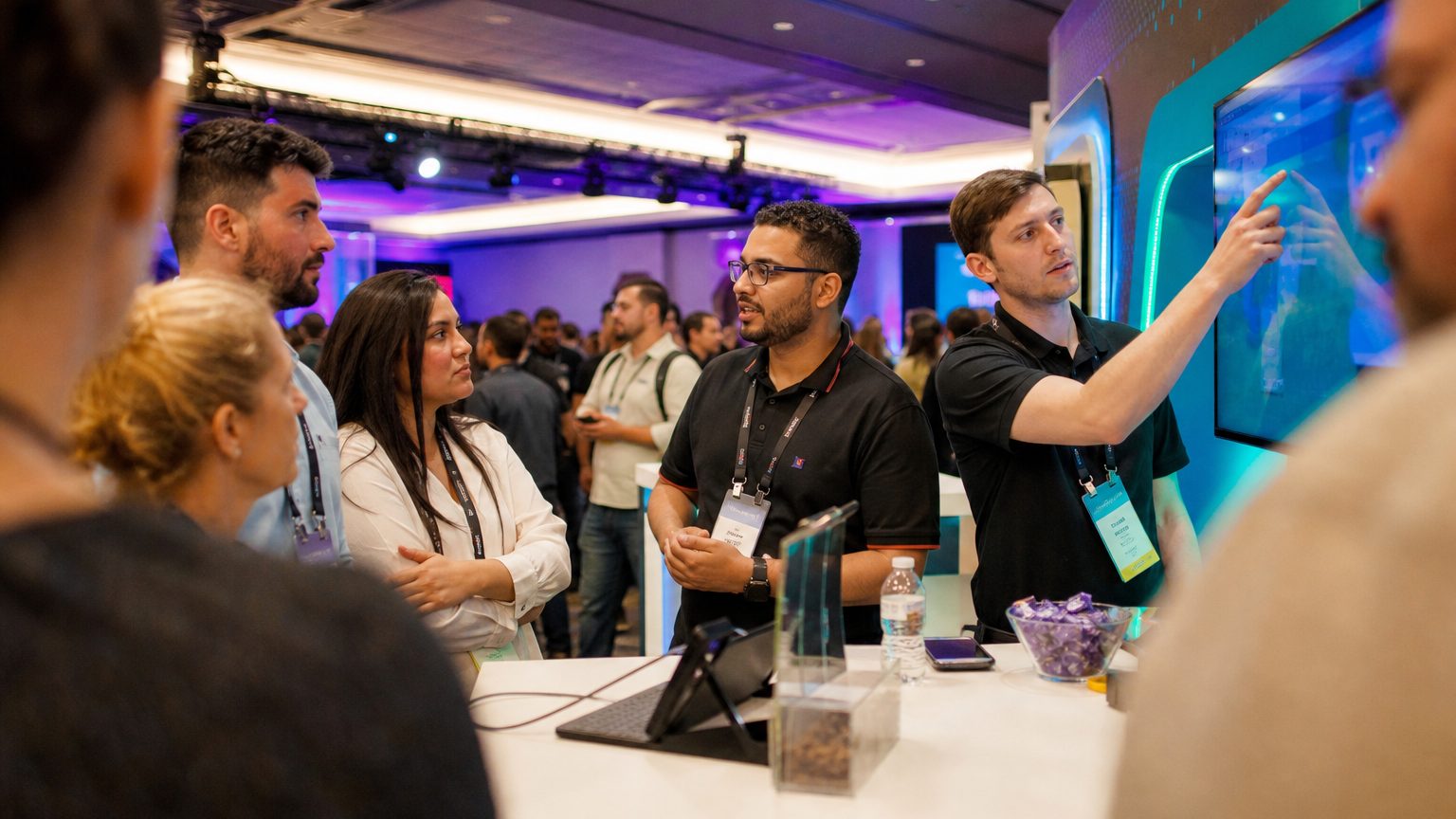
Live booth entertainment
8. Close-up magician. The most efficient body-stopper on a show floor, and a good one will hand off to a rep rather than just perform. Book on that ability, not on the trick list — ask directly how they transition someone to your team.
9. Caricature artist. Long dwell time, a takeaway with your logo on it, and a queue that reads as a crowd from down the aisle. Quality of conversation is low while they are sitting; the value is the queue.
10. Improv duo doing your pitch. Two performers who work your product messaging into short scenes on request. Memorable and rare. Needs real briefing time and a product story simple enough to be funny.
11. Mentalist. Higher-end than a magician, better suited to a booth where the audience skews senior. Costs more and delivers a smaller number of much better conversations.
12. Live illustrator or graphic recorder. Draws the show, your booth or a customer’s problem in real time. The artwork becomes social content and post-show collateral, which extends the spend past the three days.
Food, drink and comfort
13. Barista cart. Guaranteed traffic and near-zero qualification. Use it deliberately — as a reason for a scheduled meeting to happen at your booth rather than as a lead-generation tool. Check the venue’s exclusive F&B contract first; most convention centres have one and it changes the economics.
14. Local specialty. Beignets in New Orleans, brisket in Austin, cannoli in Chicago. Cheaper than a barista cart, more memorable, and it gives your team an easy opening line.
15. Phone charging lounge. Not entertainment, but it buys the thing entertainment buys — time. Seated attendees waiting on a charge are the easiest conversations on the floor.
16. Massage or recovery chairs. Day three of a show, this outperforms almost anything else. Long dwell, grateful attendee, and a rep can talk the whole time.
Content-led
17. Live podcast or interview stage. Invite customers and prospects on as guests. The guest list is the lead list, the recording is content for the rest of the year, and being asked to appear is flattering in a way a demo request is not. The highest-quality format on this page.
18. Professional headshot studio. Attendees genuinely want this, booking captures their details willingly, and delivery afterwards is a legitimate follow-up email that gets opened. Pair it with a scheduling link and the qualification happens before they arrive.
Union labour and venue rules. At most major convention centres, anything requiring rigging, power beyond a standard drop, or setup past a small size limit is union-controlled. A golf simulator that needs a dedicated circuit can cost more to plug in than to rent. Confirm the electrical order and the labour rules before you sign the entertainment contract, not after.
The handoff is the whole thing
Entertainment stops someone. It does not qualify them. The gap between a busy booth and a productive one is entirely in what happens in the ninety seconds after the trick ends or the coffee is handed over.
Three things to design before the show:
Who owns the transition. Name the person whose job is to step in when the performance ends. If it is “whoever is free,” it will be nobody.
The opening line. Not “can I tell you about us.” Something tied to the entertainment itself — the demo challenge score, what they had drawn, why they came to this show. Write it down and rehearse it.
What counts as a lead. Decide before the floor opens whether a badge scan at a prize wheel counts. If it does, your numbers will look excellent and mean nothing. If it does not, you will choose different entertainment.
Choosing yours
Work backwards from the conversation you want. If you need volume at the top of a funnel, coffee and a caricature artist will deliver it. If you need twenty senior conversations, a live podcast and a headshot studio will beat every game on this page.
Then check the three constraints that quietly decide it anyway: your booth’s power and rigging allowance, the venue’s F&B exclusivity, and how many staff you actually have on the floor at once. The best entertainment idea you cannot staff is worse than the second-best one you can.
Related reading: How Corporate Events Can Use Virtual Reality.
Exceptional Event Services
Trade Shows, Conferences, & more.