
There is a moment, about three weeks after the proposals come back, when someone in finance asks a simple question: why is this one $180,000 cheaper? And you realize you cannot answer it, because the two vendors priced two different events.
That is not a vendor problem. That is an RFP problem. A conference RFP is not a wish list — it is a specification, and the parts people leave vague are exactly the parts that come back to bite. Below is the document we would want to receive, the 2027 budget math to anchor it, and the three contract clauses that quietly decide whether you land on budget.
Why a conference RFP is not an incentive RFP with the words swapped
An incentive program is bought on experience — destination, qualifier tiers, gifting, air. A conference is bought on capacity and contract risk. Room block, function space, food and beverage minimum, attrition. None of those decide an incentive trip, and all of them decide a conference.
Send a vendor the same document for both and you get proposals you cannot compare. We covered the other side of this in the incentive travel RFP template. This one is for conferences, sales kickoffs, user conferences, and annual meetings.
The 14 fields every conference RFP must state
Copy this into your document and replace the bracketed values. Leave a bracket empty and you get a proposal built on the vendor’s assumption instead of your requirement — which is the same thing as getting no proposal at all.
- Program name and type — [PROGRAM NAME], [SALES KICKOFF / USER CONFERENCE / ANNUAL MEETING / BOARD OFFSITE]
- Attendee count, split by type — [TOTAL] total: [N] internal, [N] customers, [N] speakers, [N] staff. Vendors price staff rooms differently. Say so up front.
- Dates and flexibility — preferred [DATE RANGE]; alternates [DATE RANGE]. State whether dates are firm. Flexibility is the single largest lever you have on a venue quote, and it costs you nothing to offer.
- Pattern — [N] nights, arrival [DAY], departure [DAY], peak night [DAY].
- Room block by night — a night-by-night grid, not a single total.
- Rate basis requested — [NET ROOM RATE / DAY-DELEGATE RATE / COMPLETE MEETING PACKAGE]. Ask for one basis. Mixed bases are the most common reason two proposals cannot be compared.
- General session space — [N] people in [THEATER / CRESCENT ROUNDS / CLASSROOM], minimum ceiling height [FT], column-free required [YES/NO].
- Breakout requirement — [N] concurrent rooms at [N] people each, held [DAYS/TIMES].
- Function space hold — 24-hour hold on general session [YES/NO]. Without it, you pay to reset a room you already dressed.
- Food and beverage scope — [N] breakfasts, [N] lunches, [N] breaks, [N] receptions, [N] dinners, plus dietary accommodation expectations.
- Audio-visual scope — in-house AV required or outside vendor permitted [YES/NO]; if outside is permitted, state the patch fee. Ask for line-item AV, never a package figure.
- Internet — [N] concurrent devices, dedicated bandwidth [MBPS], streaming required [YES/NO]. Conference-grade bandwidth is a separate line item and is routinely left out of first drafts.
- Speaker and agenda scope — is the vendor sourcing talent, managing run of show, both, or neither? [SCOPE]
- Decision timeline — proposals due [DATE], shortlist [DATE], site visits [DATE], award [DATE], contract [DATE].
Building a budget anchor you can defend
Do not ask a vendor what this will cost. Build the anchor yourself, then read their proposal against it. What follows is arithmetic from published 2026 benchmarks — every step is shown so you can swap in your own rates and your own market.
The program: 300 attendees, 3 nights, one general session, four breakouts.
Rooms
U.S. hotel average daily rate hit a record — roughly $162 — in 2026, with forecasts calling for another 1–3% in the year ahead. Ignore that number. ADR is a national average across every hotel in the country, including the airport property with no ballroom. A hotel with a column-free general session space and four breakouts under one roof prices well above it, and in a major convention market those ballrooms are commonly booked 12–18 months out. For a tier-one or strong secondary market, $250–$325 is a realistic planning band. Working at $315:
Food and beverage — and the part that surprises people
Hotel banquet catering runs $75–$200+ per person per meal in 2026. Build the day rather than guessing at it — breakfast $48, lunch $82, two breaks $45, evening reception $95 comes to $270 per person per day. Across the program:
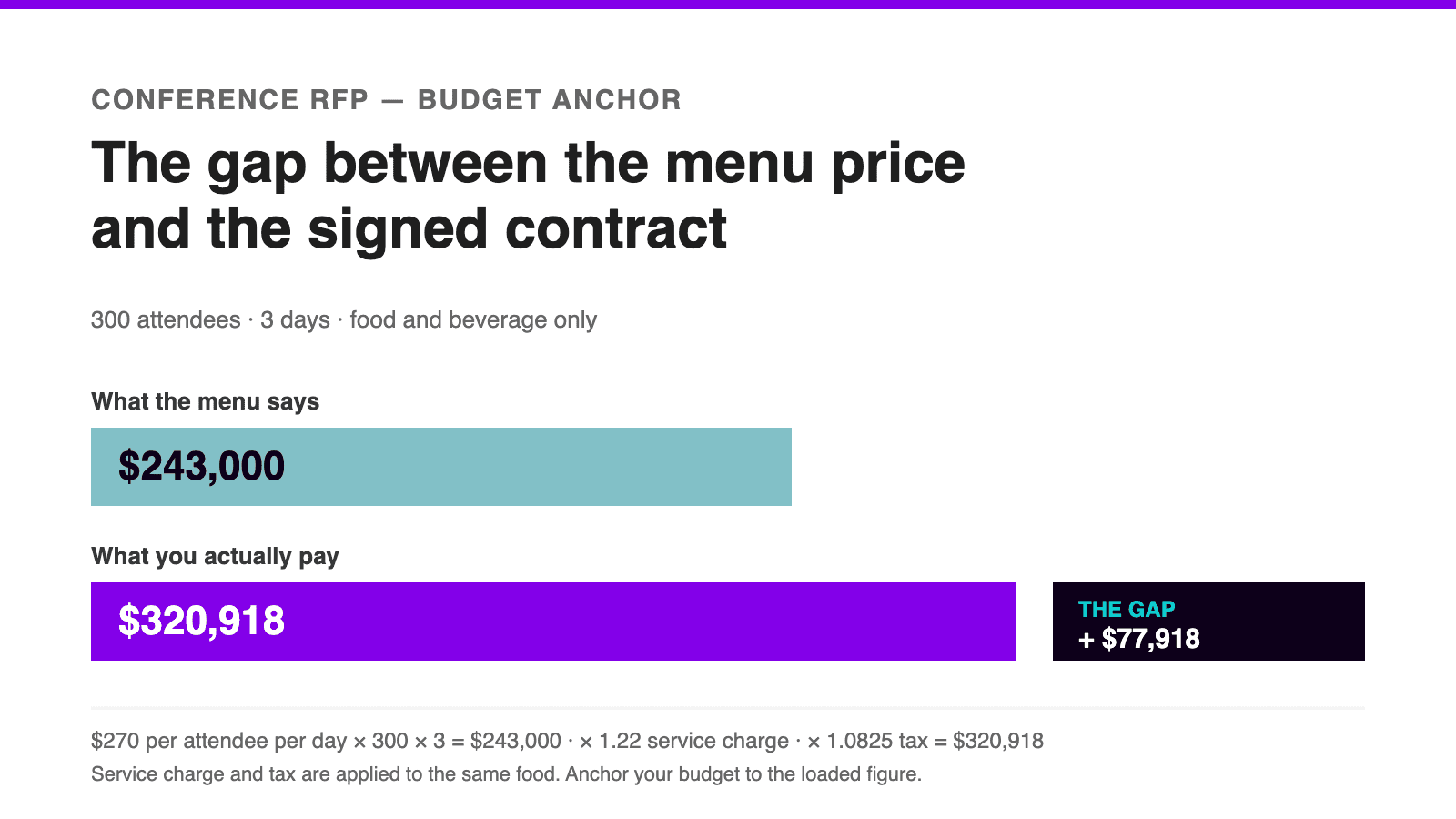
That works out to $810 per attendee, which lands right on the published benchmark of roughly $867–$940 per attendee for conference F&B. So far so good — except that is the menu price, and the menu price is not what you pay.
Service charge on banquet F&B typically runs 18–24%, most commonly 18–22%, and contracts as high as 28% have shown up in the market. Tax stacks on top. At a 22% service charge and 8.25% tax:
$296,460 × 1.0825 = $320,918
That is $77,918 above the menu number, on exactly the same food. It is the most common gap between a first-draft budget and a signed contract, and it is why 69% of planners report F&B coming in higher than they expected. Put the loaded figure in your anchor. Nobody has ever been talked out of a program by an honest number, but plenty of people have been embarrassed by an optimistic one.
Audio-visual
This is where budgets go quietly wrong, because AV is quoted in tiers and most people anchor to the wrong one. Current 2026 production pricing runs roughly $25,000–$75,000 for a bare single-room general session, $75,000–$175,000 once you add branded staging and moderate LED, and $175,000–$350,000 for a genuine multi-day, multi-room conference. AV is typically the second-largest line in a conference budget after F&B, at around 19% of total spend.
A three-day general session with branded staging plus four breakout rooms is not the entry tier. Working in the second band:
$95,000
If a vendor quotes you $40,000 for this scope, they are quoting a screen and a speaker, not a production. Ask what tier their number assumes.
The anchor
$283,500 + $320,918 + $95,000 = $699,418
One caveat worth stating plainly: this anchor covers venue-side cost only — rooms, food, AV. It does not include speakers, marketing, registration technology, staff travel, or your own team’s time. Add those and the per-attendee figure moves materially. Anchor the venue conversation with this number; budget the program with a bigger one.
A proposal that comes in well under this is not necessarily a better deal. It is a question: what scope is missing, or what service-charge basis did they assume that you did not ask for? Find out before you shortlist it.
The three clauses that decide the outcome
Attrition
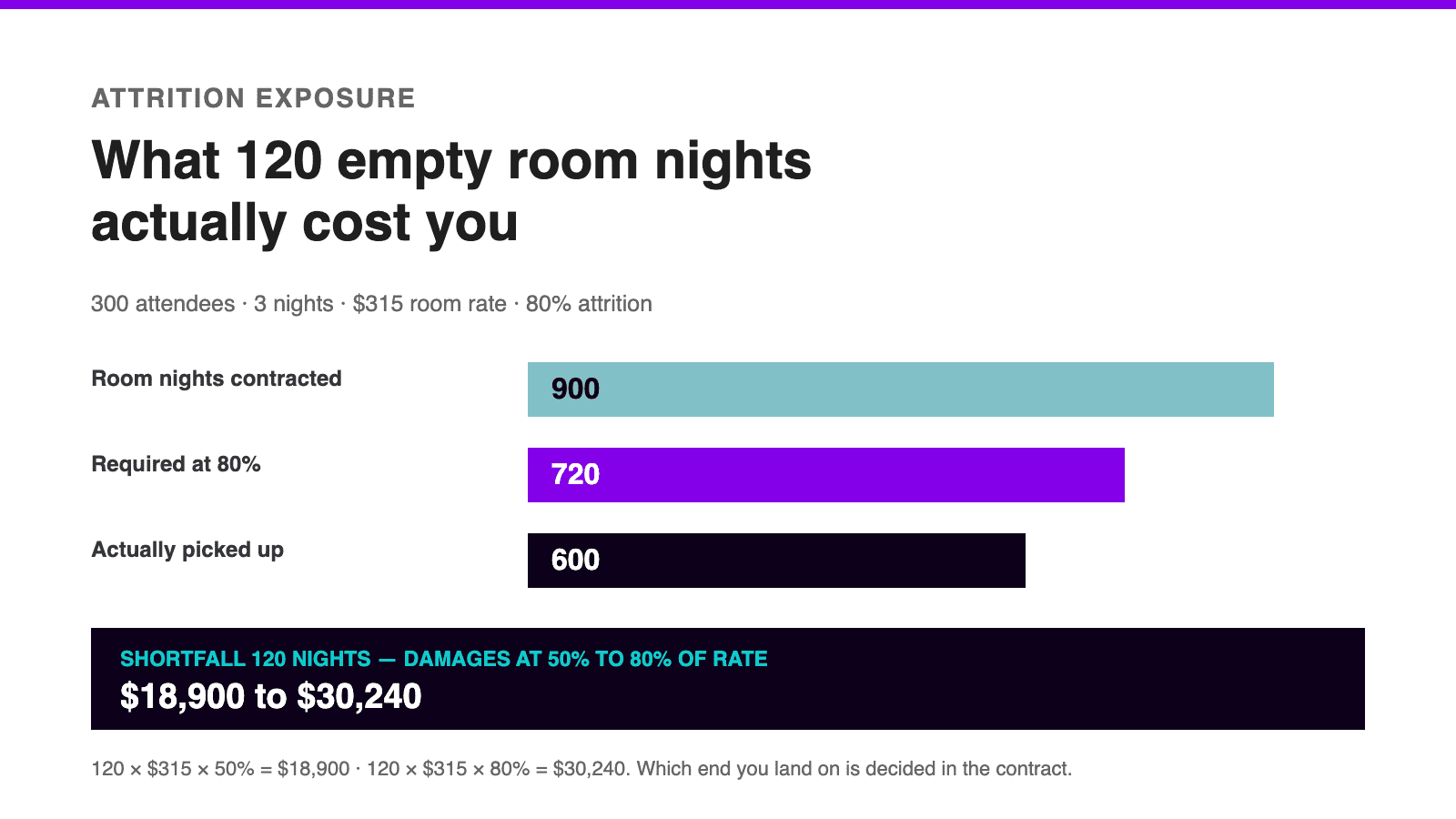
Attrition is the share of your room block you must actually fill before penalties apply. Industry standard sits around 80%, though most contracts land somewhere in the 80–90% range — and the difference between those two numbers is real money.
Here is the part most articles get wrong: the penalty is usually not the full rate. Attrition damages commonly run 50–80% of the room rate, because the hotel saves on housekeeping and amenities for a room nobody used. So the exposure is a range, not a number:
120 × $315 × 80% = $30,240
Somewhere between $18,900 and $30,240 for rooms nobody slept in. Which end you land on is decided in the contract, months before anyone books a flight.
Three asks, in order of what they are worth to you. Ask for attrition measured cumulatively across the whole block rather than night by night — cumulative is almost always the more forgiving method, and it is a free ask. Ask whether rooms your attendees book outside the block count toward pickup; in a world where half your people have a loyalty account, this one question can be worth more than the rate negotiation. And ask for the damages percentage in writing, because 50% and 80% are both “standard.”
Food and beverage minimum
The F&B minimum is a floor you must spend. The contract should state plainly whether service charge and tax count toward it. Usually they do not — which means on a $200,000 minimum, a venue excluding a 22% service charge is effectively asking for roughly $244,000 of your budget to clear the same bar. Get the basis in writing, in the RFP, before anyone quotes.
Force majeure
Ask for language that triggers on impracticability, not only on literal impossibility. Ask that it cover your attendees’ ability to travel, not just the venue’s ability to open its doors. Ask for pro-rata reduction for partial disruption rather than an all-or-nothing termination right. And confirm whether the notice window is measured in calendar days or business days, because over a holiday week that distinction has teeth.
A weighted scorecard for conference proposals
Score each vendor 1–5 per criterion, multiply by weight, sum. Agree the weights before proposals arrive. Weights set afterward are not evaluation, they are rationalization.
| Criterion | Weight | What a 5 looks like |
|---|---|---|
| Function space fit | 20% | General session and all breakouts under one roof, 24-hour hold included |
| Total contracted cost | 20% | Line-item, single rate basis, service charge and tax shown separately |
| Contract risk terms | 20% | Attrition at or below 80% cumulative, damages percentage stated, F&B minimum basis defined |
| AV and bandwidth | 15% | Itemized AV, outside vendor permitted, dedicated bandwidth quoted separately |
| Room block and rate basis | 15% | Night-by-night grid honored, outside bookings count toward pickup |
| Team and references | 10% | Named on-site lead, three references at comparable scale |
Cost and contract terms carry 40% between them, because on a conference they are the same conversation. A low rate attached to 90% night-by-night attrition is not a low rate. It is a bet.
Running the process without wasting everyone’s time
Send to four vendors, not ten. Give them three weeks. Answer questions in writing to all bidders at once, so nobody is quoting a different scope than everyone else. And require the response in your format, not theirs — a vendor who will not fill in your grid at the proposal stage will not follow your process on site either. That is not a small tell. That is the whole tell.
Questions we get asked
How far out should we issue a conference RFP?
Nine to twelve months for a 300-person program in a competitive market, and closer to fifteen if you need a specific property in Q1 or a city hosting a major citywide that week. Ballrooms in the top convention markets are commonly booked 12–18 months ahead. Below six months you are not choosing a venue, you are accepting one.
Should we run the hotel RFP ourselves or let the agency do it?
If your scope is only rooms and meeting space, run it yourself. If it spans agenda, production, registration, and on-site management, issue one agency RFP and let your partner source the hotel inside it. Doing both usually means doing the agency’s work for free and getting worse terms than they would have negotiated.
What is the difference between a net rate, a day-delegate rate, and a CMP?
A net room rate is rooms only. A day-delegate rate bundles meeting space, some F&B, and basic AV per person per day. A complete meeting package adds guest rooms to that bundle. All three are legitimate. Mixing them across bidders is how you end up unable to answer finance’s question.
Is 80% attrition negotiable?
Frequently, yes — and the damages percentage inside it is often more negotiable than the threshold itself. Groups with flexible dates, shoulder-season patterns, or strong F&B spend relative to room nights have real leverage here. Ask.
If you would rather not build this from scratch
We run corporate conferences nationwide — sales kickoffs, user conferences, and annual meetings from a few hundred people to a few thousand, in every major U.S. market and plenty of secondary ones. Building the requirement document is where the money is actually saved, long before anyone signs anything.
If you would like a second set of eyes on your scope, your budget anchor, or a contract someone has already put in front of you, our conference and meeting planning team does this work every week. Get in touch and we will walk through it with you — no deck, no pitch.
Further reading
The Northstar Meetings Group industry forecast tracks year-over-year cost movement across rooms, F&B, and labor, and is worth a read before you set any budget anchor. If you are sourcing an incentive program in the same cycle, our incentive travel RFP template covers the very different document that requires. Exhibiting too? The trade show RFP template covers show services and drayage.
Need the agenda rather than the vendor brief? See our conference agenda template with three worked examples, or the free agenda template pack.