
Every exhibitor has had the same conversation. The booth cost what the booth cost. Then the show services invoice arrived, and somehow the floor space you budgeted at $16,000 turned into a $30,000 line item before a single person walked the aisle.
That gap is not padding. It is drayage, electrical, carpet, labor, and a dozen order forms with early-bird deadlines you missed by four days. And it is entirely predictable — if your RFP asks the right questions before you hire anyone.
What you are actually buying
Three very different companies will answer a trade show RFP, and they are not interchangeable.
A booth builder designs and fabricates the physical exhibit. Excellent at the thing they do. Not responsible for whether your freight arrives on time.
A show services contractor is appointed by the show organizer. You do not choose them, you order from them, and their rate card is not negotiable in any meaningful way.
An exhibit program partner runs the whole calendar — asset management across shows, freight and drayage strategy, labor, show services ordering, booth staffing, lead capture, and the reporting that tells you whether any of it worked. This is what most companies searching for a trade show RFP template actually need, and it is the document below.
If you only need a box built, do not run this RFP. If you are exhibiting at six shows a year and cannot say what your cost per qualified lead was at any of them, keep reading.
The show-services math your budget is probably missing
Here is a 20×20 island — 400 square feet — priced from published 2026 benchmarks. Every step is shown so you can substitute your own show and your own weights.
Floor space. Booth space averages $20–$40 per square foot and typically accounts for around a third of an exhibit budget. Major shows in major markets sit at the top of that band, so at $40:
400 sq ft × $40 = $16,000
400 × $5.50 = $2,200
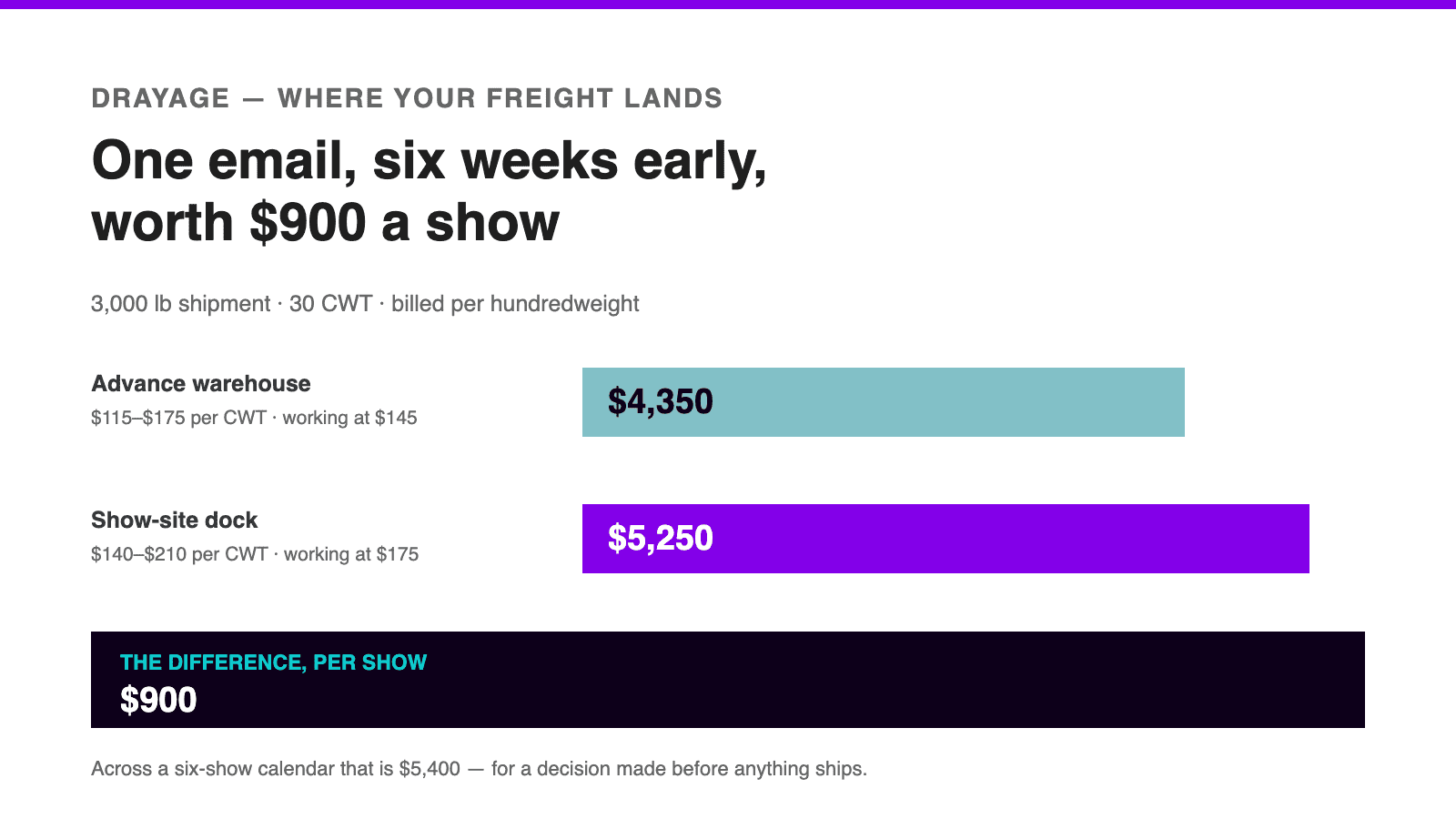
Drayage. This is the one that gets people. Material handling is billed per hundredweight (CWT), and where your freight lands changes the rate. Advance warehouse rates at major hubs average $115–$175 per CWT; consign directly to the show-site dock instead and you are looking at $140–$210. On a 3,000-pound shipment — 30 CWT:
Show-site dock at $175/CWT: 30 × $175 = $5,250
That is $900 for a decision that takes one email, made six weeks earlier. Multiply it across a six-show calendar and the freight strategy alone pays for a meaningful share of what you are about to spend on a partner.
Installation and dismantle labor. The line most first-draft budgets forget entirely. At most major convention centers this work is union-controlled — past a small size limit you cannot legally set up your own booth, so you hire the crew through the show contractor or an approved I&D company. Union I&D labor runs around $100 per hour, typically with a four-hour minimum, and rates and jurisdictions vary by venue. A 20×20 island is not a two-person job: figure a four-person crew for a full install day and half that for dismantle.
Dismantle: 4 workers × 4 hours = 16 hours
48 hours × $100 = $4,800
Worth knowing why that rate looks steep: only about 25% of it reaches the worker. The rest covers taxes, insurance, and benefits. Arguing about it is a poor use of your energy; planning around it is not.
Electrical and internet. $500–$2,000 depending on draw and whether you need a hardwired line. At $1,500.
Furniture rental. $200–$1,000+. At $800.
What it actually lands at
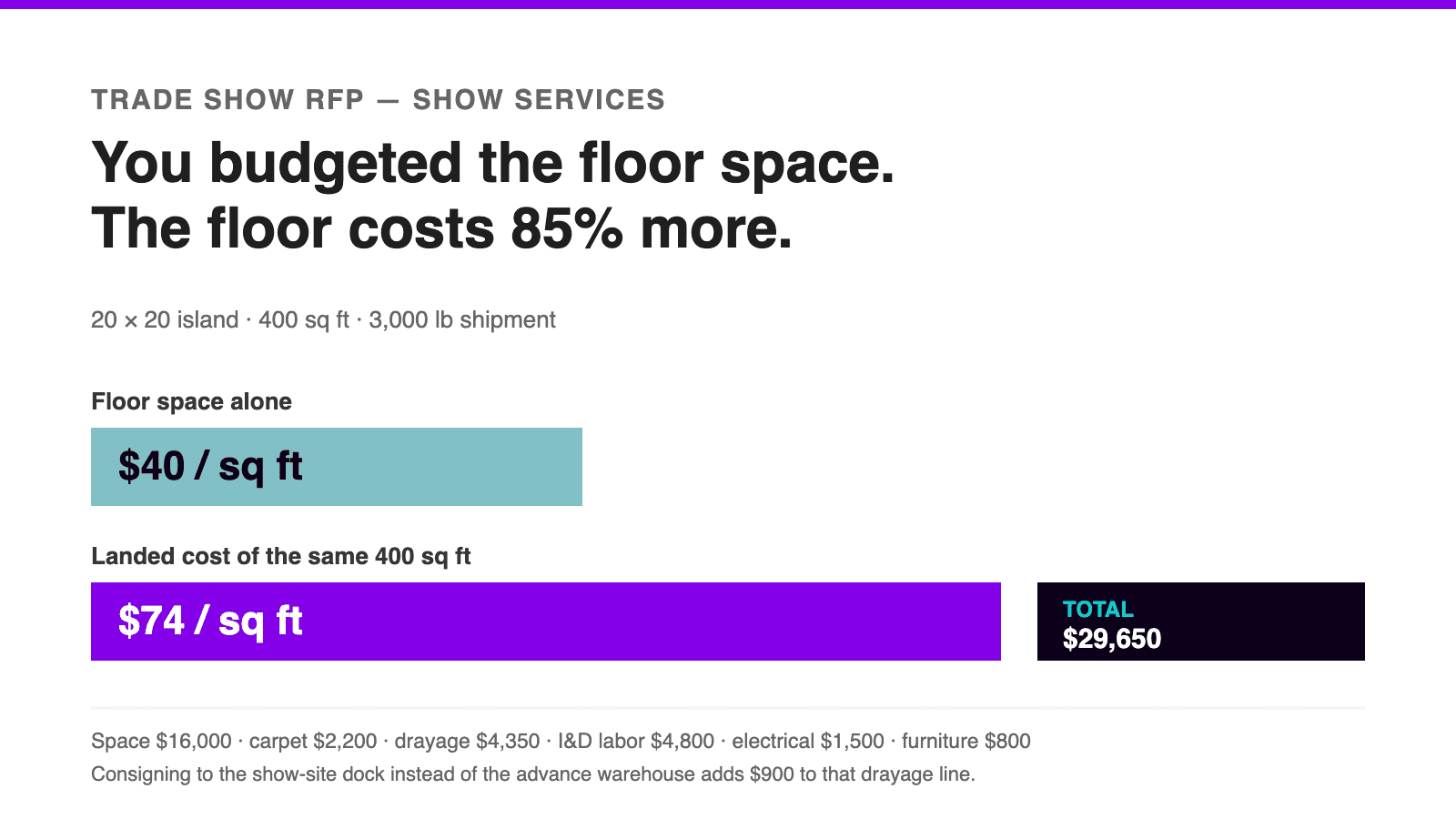
$16,000 + $2,200 + $4,350 + $4,800 + $1,500 + $800 = $29,650
You budgeted floor space at $40 per square foot. The floor is costing you $74 — roughly 85% more — and none of that includes the exhibit itself, freight to and from the show, staff travel, or a single thing you hand to a visitor. Drayage alone can consume up to 18% of a total exhibition budget, and it is consistently the most underestimated line in the category.
Put this arithmetic in your RFP. A vendor who cannot walk you through their version of it is not managing your program. They are forwarding your order forms.
The 14 fields every trade show RFP should state
- Show calendar — [SHOW NAME, CITY, DATES, BOOTH NUMBER IF ASSIGNED] for every show in scope, with tiers if some matter more.
- Booth footprint and configuration per show — [SIZE], [INLINE / PENINSULA / ISLAND], hanging sign permitted [YES/NO].
- Exhibit asset status — do you own properties, rent, or need something built? If you own, state age, condition, and whether it is modular.
- Storage and asset management — who warehouses the exhibit between shows, who inventories it, and who is liable for damage in transit.
- Installation and dismantle scope — supervised or turnkey, union jurisdictions in play, expected overtime windows.
- Freight and drayage management — who books freight, who decides advance warehouse versus direct-to-dock, and who reconciles the material handling invoice against actual weight. Ask this one out loud.
- Show services ordering — electrical, rigging, internet, cleaning, lead retrieval. Name who owns the deadlines, because early-bird pricing is the cheapest discount in this industry and the easiest to miss.
- Booth staffing and training — how many staff, from where, and does the partner train them on qualifying questions or just schedule shifts.
- Lead capture and CRM integration — device or app, required fields, qualification scoring, and the handoff into [YOUR CRM]. State the system by name.
- Pre-show and at-show marketing — meeting-booking campaigns, target account outreach, in-booth demos or theater programming.
- Hospitality and meetings — customer dinners, suite meetings, or private space adjacent to the show floor.
- Measurement — the metrics you will judge the program on: leads, qualified leads, meetings held, pipeline sourced, cost per qualified lead.
- Budget and billing model — annual program budget, per-show allocation, and how the partner bills. Ask for the billing structure in writing; it is a fair question and a straight answer is a good sign.
- Decision timeline — proposals due [DATE], shortlist [DATE], presentations [DATE], award [DATE].
The questions that separate a partner from a supplier
Put these in the RFP verbatim. The answers sort the field faster than anything else you will ask.
| Ask them this | What the answer tells you |
|---|---|
| “Walk us through a material handling invoice you disputed and what you recovered.” | Drayage is billed on estimated weight far more often than anyone admits. A partner who has never audited one has never looked. |
| “What is our current cost per qualified lead, and how would you calculate it?” | Most exhibitors cannot answer this. The vendor’s method matters more than the number. |
| “Which of our shows would you tell us to drop?” | A partner with an opinion is worth more than one who will happily run all twelve. |
| “How do you handle a booth that arrives damaged on setup morning?” | Not whether — how. Everyone has a story. Listen for whether it ends with a solved problem or a blamed carrier. |
| “Who is on site, and are they the person in this room?” | The most common disappointment in this category is a strong pitch team and a stranger at the show. |
A weighted scorecard for exhibit program proposals
| Criterion | Weight | What a 5 looks like |
|---|---|---|
| Program management and on-site execution | 25% | Named on-site lead, documented escalation path, references at comparable show scale |
| Logistics and cost control | 20% | Freight strategy stated per show, invoice audit process, deadline calendar owned by them |
| Measurement and lead handling | 20% | Defined qualification criteria, named CRM integration, reporting cadence after each show |
| Exhibit design and asset strategy | 15% | Modular reuse across footprints, storage and refurbishment plan, not a new build every year |
| Total program cost and billing clarity | 15% | Line-item by show, billing model stated plainly, assumptions documented |
| References and stability | 5% | Three references running comparable calendars, team continuity |
Logistics and measurement carry 40% between them on purpose. Design is the part everyone enjoys evaluating and the part least likely to determine whether the program works.
Questions we get asked
How far ahead should we issue a trade show RFP?
Six to nine months before your first show of the season, and ideally before space selection for the following year opens. Signing a partner after your booth assignments are locked means hiring someone to execute decisions they had no say in.
Should we run one RFP for all our shows or one per show?
One, covering the calendar. Program-level scope is where the savings live — shared assets, consolidated freight, one set of deadlines, one report that compares shows against each other. Per-show sourcing gives that up for very little in return.
What is I&D labor?
I&D stands for installation and dismantle: the crew that physically builds your booth on the show floor and tears it down afterward. At most major convention centers the work is union-controlled, so past a small size limit you cannot set it up yourself. Expect roughly $100 per hour with a four-hour minimum, varying by venue and jurisdiction.
Is drayage negotiable?
The published rate, essentially never — the general contractor is appointed by the organizer. What is negotiable is everything that determines what you pay: shipment weight, packaging, whether you consign to the advance warehouse, how many separate pieces arrive, and whether anyone checks the billed weight against the actual weight. That is where a good partner earns their keep.
If you would rather have a partner than a vendor list
We manage trade show programs nationwide, alongside corporate conferences and incentive programs, for companies exhibiting at anywhere from two shows a year to twenty. The work that matters happens in the eight weeks before anyone builds anything.
If you want a second read on your scope, your show calendar, or a proposal already sitting on your desk, our trade show management team is happy to look. You may also want the conference RFP template if you are sourcing meeting space in the same cycle, or the incentive travel RFP template if a President’s Club program is on the calendar. Get in touch and we will walk through it.