Every NYC event has two budgets: the one in the proposal and the one that shows up on the final invoice. The gap between them is where careers get complicated. It is almost always driven by the same handful of line items — service charges stacked on gratuity, sales tax applied to both, union call minimums no one flagged in the walkthrough, and the FDNY letter of no objection that quietly added two weeks to the timeline.
This is a working guide to corporate event planning in New York, written for the person who has to defend the number to a CFO. Not a venue roundup. Not a pitch. The venue lists are already everywhere — what is missing is the operator math: how a quoted headline number becomes the real number, which permits apply where, what union rules trigger at which addresses, and when the standard 12-to-18-month lead time is nonsense versus when it is not nearly enough.
We plan programs across the country from our home base — you can see how we approach the discipline on our conferences and meetings practice page — and New York is its own animal. Here is how we think about it.
What Nobody Tells You About Running Corporate Events in NYC
Most articles ranking for this term fall into one of two buckets. Agency landing pages that describe services without pricing specifics, or venue directories that list capacities without any of the planning process attached. Nobody stitches the two together. That is the whole problem — the venue and the plan are the same conversation, and pretending otherwise is how programs blow past their approved range.
A few things a New York program has that a Dallas or Nashville program does not:
- Union labor at named venues. Javits Center, Lincoln Center, Radio City, and most Broadway houses are union properties. IATSE, Teamsters, and stagehand locals set your load-in crew size before you have picked a lighting designer.
- FDNY assembly permits. Any temporary place of assembly for 75 or more people in a space not already permitted for that use needs a Public Assembly permit or a Place of Assembly certificate. Rooftops and lofts are the usual triggers.
- Compounding taxes and service charges. The 8.875% NYC sales tax plus a 22-24% service charge plus gratuity on F&B minimums is how a proposal grows by roughly a third between signature and settlement.
- Neighborhood-specific SLA rules. One-day liquor permits from the New York State Liquor Authority take real lead time and are not automatic for every space.
None of this is exotic. It is just table stakes that gets skipped when a national planner drops into New York without a local production partner.

What a Corporate Event Planner in New York Actually Does
The job title collapses about six different disciplines. A good corporate event planner in New York is running venue sourcing, production design, F&B negotiation, permit and insurance workflow, vendor management, and on-site run-of-show at the same time. The bad ones do two of those and outsource the rest without telling you.
Sourcing and Venue Economics
Sourcing in New York is not a list-generation exercise. It is a math exercise. The right question is not “which venues fit 300 people” — Zipcube and Peerspace already answer that — but “which venues fit 300 people on a Thursday in October at a food and beverage floor we can actually hit, with a load-in window our AV vendor will accept, in a labor tier that matches the format.” That filter cuts a list of 40 venues to about six.
Production and AV Coordination
Whether the production is in-house at the venue or subcontracted changes the number more than anything else on the invoice. Convene properties run their own AV and it is competent and predictable. Raw loft spaces in Chelsea and DUMBO need a full production build, which means a lighting designer, an audio engineer, a video crew, rigging, and a stage — priced separately.
On-Site Execution
The show call is where planners either earn their fee or explain later why the CEO’s walk-on music did not fire. Real on-site execution means a printed run-of-show with cues down to the minute, a stage manager who has done at least a hundred of these, and a comms plan for the moment the ballroom’s house sound cuts out because a hotel engineer flipped the wrong breaker. It happens.
The True Cost Math: How a Quoted Number Becomes the Real Number
The single biggest failure mode in New York planning is quoting a headline F&B number to a stakeholder and forgetting to layer the compounding charges on top. The stack, in order:
- Base F&B floor from the venue (the number in the proposal)
- Service charge, typically 22-24% in New York, applied to the F&B floor
- Administrative or house fee at some venues, another few points
- Gratuity, sometimes separate from service charge, sometimes bundled
- NYC sales tax at 8.875%, applied to the F&B floor and, at many venues, to the service charge as well
The compounding effect moves the quoted floor up by roughly 30-35% by the time it lands on the final invoice. That is before any AV, rentals, entertainment, or staffing. Any planner who quotes a floor without walking a stakeholder through the stack is setting up a fight in month six. The Cvent research team has published useful benchmarks on how in-market service-charge structures move over time — worth reading before your next NYC RFP.
Instead of naming a per-attendee number here — because pricing lives in the quote conversation, not in a public guide — think in tiers. A midweek breakfast meeting at a hotel is a different tier from a Thursday-night cocktail reception at a waterfront venue, which is a different tier from a full gala at Cipriani or Pier Sixty. If you want a real range for your specific format, headcount, and month, that is what an RFP is for.
The NYC Compliance Stack: Permits, Insurance, and Union Labor
This is the section most of the ranking pages skip entirely, which is odd because it is where programs actually go sideways.
FDNY Public Assembly Permits
Temporary places of assembly for 75 or more people in a space not otherwise certified need a Public Assembly permit. Rooftops, industrial lofts, warehouse conversions, and gallery spaces are the usual triggers. Expect a two to four week processing window. The FDNY inspector shows up in advance and can require exit signage, extinguishers, or crowd-flow changes that your venue walkthrough did not surface.
SLA One-Day Liquor Permits
If the venue does not have a full liquor license, or the format changes the license type (a private corporate event in a normally-public space, for example), you need a one-day permit from the New York State Liquor Authority. Fifteen business days minimum, and not every neighborhood approves them the same way.
Certificates of Insurance
Every real NYC venue requires a COI naming the venue, the building owner, and often the management company as additional insured, with specific limits — commonly one million per occurrence, two million aggregate, with higher limits at flagship museums and unionized venues. The client’s corporate policy usually covers this; the planner drives the request. Missing COIs delay load-in more often than any other single item.
Union Labor
At Javits, Lincoln Center, Radio City, most Broadway houses, and some hotel ballrooms, IATSE and Teamsters rules apply. Call minimums are typically four hours. Overtime kicks in earlier than most out-of-market planners expect. If a venue is unionized and the client’s AV vendor is not, the venue’s house crew has to be paid regardless of whether they touch the gear. The MPI education library has good briefings on union venue workflow if you are running your first one.
Choosing New York Corporate Event Venues by Neighborhood and Use Case
New York corporate event venues sort into a handful of practical buckets. Match the format to the neighborhood, not the other way around.
Midtown Hotel Ballrooms
The Glasshouse, The Pierre, The Plaza, the Marriott Marquis, the New York Hilton. Best for multi-day conferences and gala dinners where a room block matters. Predictable AV, predictable service charges, and the F&B floors reflect the location.
Waterfront and Skyline Venues
Pier Sixty, The Lighthouse at Chelsea Piers, Current at Chelsea Piers, Tribeca Rooftop, Rainbow Room. Best for high-touch client events, product launches, and awards nights where the visual matters. Book far out — the Rainbow Room in December is a specific problem.
Chelsea and DUMBO Lofts
Skylight venues, 26 Bridge, The DL. Best for creative-brand activations and launches. These are raw canvases; the F&B floor is usually lower than a hotel but the production build is higher. Net-net often close, sometimes higher.
Museum and Cultural Venues
American Museum of Natural History, Brooklyn Museum, the Intrepid, the New York Public Library. Prestige matters, permits and after-hours labor are specific, and photography rules can be restrictive. Beautiful when they work.
Convene and Purpose-Built Meeting Spaces
Convene locations at 101 Park, 117 W 46th, and elsewhere are designed around corporate meetings — dedicated meeting technology, on-site catering, and pricing structures built for the format. Not a fit for a 500-person gala; a very good fit for a 150-person leadership offsite.
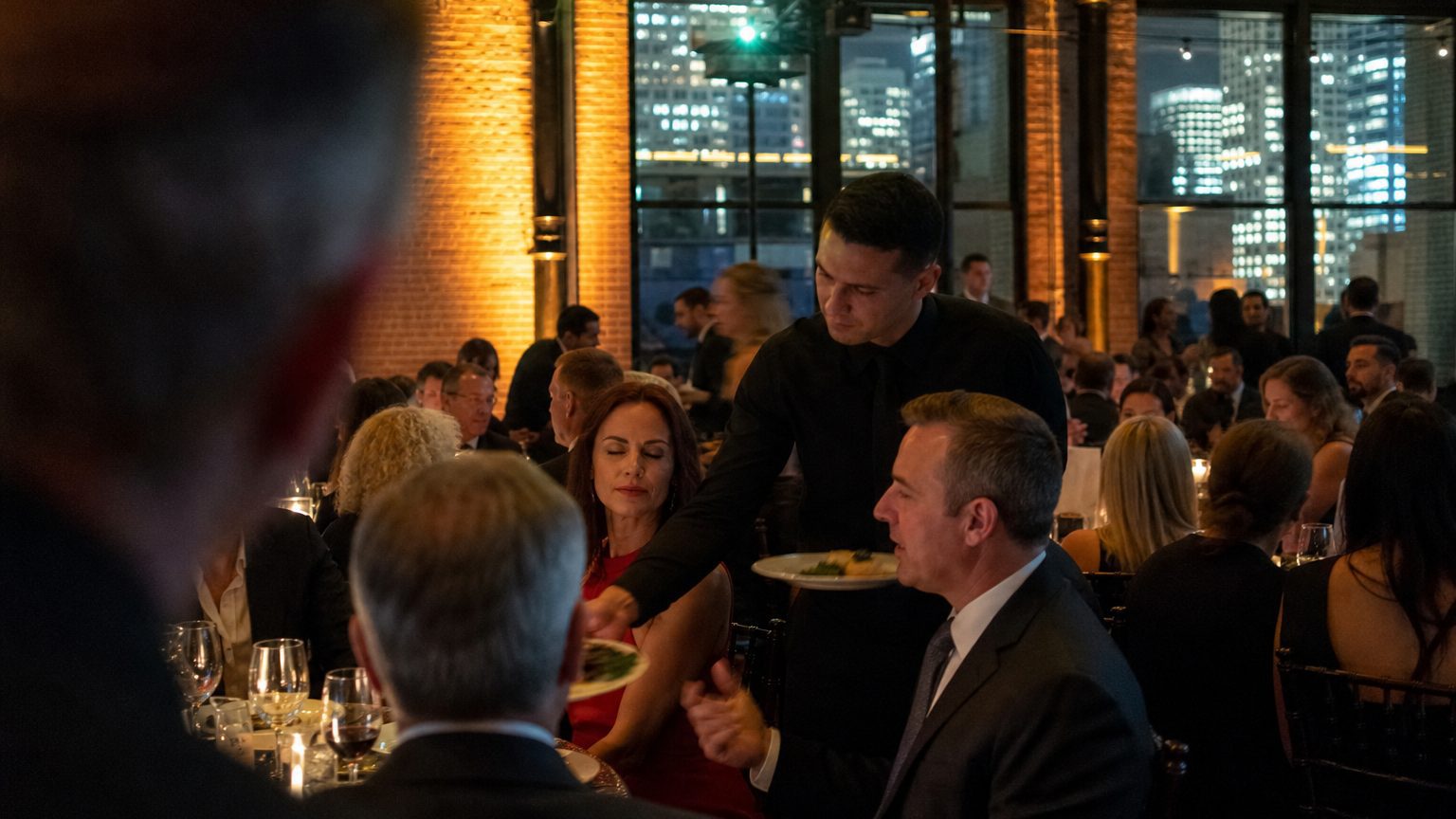
Lead Times That Reflect Reality, Not the 18-Month Cliché
Every guide repeats “book 12 to 18 months out.” It is not wrong in the abstract, but it is useless in practice because it does not segment by venue tier or month.
- Cipriani Wall Street, Pier Sixty, The Glasshouse, Rainbow Room in Q4: 12 months minimum. December Thursdays and Fridays sell out over a year in advance.
- Convene meeting spaces, hotel ballrooms in shoulder season: 4 to 6 months is usually workable.
- Midweek breakfast at a boutique hotel in February: 4 to 6 weeks. We have booked programs in ten days when calendars aligned.
- September conferences of any size: the New York September crunch is real. UN General Assembly week, New York Fashion Week, and the return-to-office conference calendar all collide. Nine months minimum for anything above 200 people.
The corollary matters too: if a client comes to us in April wanting a December holiday party at a marquee waterfront venue for 400 people, the honest answer is often “the venue you are picturing is gone; here are the three that are still available and here is why one of them is actually better for your format.” That conversation, early, is worth more than any timeline chart.
A Real RFP Scorecard for Vetting an Event Management Company in New York
The “hire local because they know the vendors” advice is thin. Every planner in New York says they know the vendors. Here is what actually separates an event management company in New York that will run your program cleanly from one that will hand you a subcontractor’s mistakes:
- References from your industry, at your scale. Not “we’ve done financial services events.” Names, headcounts, formats.
- In-house production vs subcontracted. Neither is wrong; you need to know which, and who signs the check.
- Insurance limits and additional-insured language. Ask for a sample COI.
- Force majeure and kill-fee structure. Post-2020 this should not require asking twice.
- Stage manager and technical director resumes. The on-site lead is the whole game; anyone can send a proposal.
- Sample run-of-show from a comparable past event. Redact the client name. The document tells you everything about how they think.
- Explicit statement of what is and is not included. “Full-service planning” means whatever the contract says it means.
If a planner cannot produce these on request, the answer is not “maybe.”
Measuring ROI: What to Actually Report Back to the Business
Ranking pages love the word ROI and rarely define it. The SITE Index and the IRF research library both publish frameworks worth using rather than inventing your own. For a corporate event, the useful metrics fall into three buckets:
- Attendance and engagement: registration-to-attendance conversion (a healthy internal event holds 85%+), session dwell time, app engagement rates.
- Business outcome: pipeline sourced or influenced for revenue events, employee net promoter score for internal events, retention lift on incentive programs.
- Operational: program came in within the approved range, zero compliance incidents, post-event satisfaction above the internal benchmark.
Pick three. Report on them. Do not put fifteen metrics in a deck no executive will read.
Worked Example: A 250-Person Product Launch in Chelsea
To make the moving parts concrete, here is a program we have run variations of many times. A software company launches a new product on a Wednesday evening in October. 250 attendees, mostly customers and press, in a Chelsea loft.
- Format: Two-hour cocktail reception, 25-minute product demo on a small stage, DJ after. Load-in Tuesday afternoon, load-out same night after 11pm.
- Venue tier: Raw loft, so the base venue rental is moderate but the production build is significant. Expect this to net out higher than a comparable hotel space by roughly 15-20%.
- Production: Lighting design, line-array audio, IMAG cameras and a switcher, a 24-foot LED wall behind the stage. Comfortably a top-tier build.
- F&B: Passed hors d’oeuvres, three bar stations, a coffee and dessert moment. The service-charge stack described above adds roughly 30% to whatever the base F&B floor lands at.
- Permits: FDNY Public Assembly required. SLA one-day permit if the venue is not full-licensed. COIs to the venue and building owner, standard limits.
- Staffing: Two planners on site, a stage manager, a technical director from the production vendor, a coat check lead, four brand ambassadors for check-in, security at the door per venue requirement.
- Timeline: Kickoff nine months out. Venue confirmed by month seven. Production scope locked by month five. Run-of-show draft one at month three. Final everything at week two.
Every one of those line items is a negotiation. The number the client sees at the end is the sum of a hundred small decisions made over nine months.
Ready to Scope Your 2027 New York Program?
If you are working a 2027 launch, conference, or client event in New York and want a partner who will walk you through the real math before the RFP goes out, that is exactly the conversation we like to have. Reach out through our contact page with your format, headcount, and target window, and we will come back with a working scope — not a pitch deck. If your program spans multiple markets, our Dallas practice handles the same discipline in a very different city, and we run both.