Open any of the top-ranking conference agenda templates and you get the same thing: a pretty grid, a couple of vague headers, and zero guidance on how long a keynote should actually run. Canva sells you a design. Asana sells you a project view. Microsoft sells you a Word file. None of them tell you that a 60-minute keynote at 9 a.m. is where energy goes to die, or that if you schedule lunch at noon on day two, half the room is still in the breakout hallway at 12:20.
For the full playbook, see our conferences and meeting planning guide.
This piece does the opposite. Below are three fully worked agendas with real hour-by-hour blocks, defended with session-length research from PCMA, MPI, and Cvent. Plus the things nobody else covers: hybrid time-zone stacking, accessibility slots, sponsor placement, and the swap template for when your Tuesday keynote texts at 6:47 a.m. saying their flight canceled.
We plan conferences and incentive programs for a living, so consider this the version we’d hand a client who asked for a template on a Friday afternoon. Nothing here is theoretical.
Why most conference agenda templates fail you
The templates in the SERP fall into two buckets. Design galleries (Canva, Template.net) that hand you a layout with no logic. And process posts (Zoom, Atlassian, Asana) that list what to include without ever quoting a real minute count. Both leave the planner doing the actual work: how long should a panel be, when do people actually need coffee, where does the sponsor demo go without killing engagement.
The research on this exists. According to PCMA, attendee attention on passive content drops sharply past the 45-minute mark. MPI and the EventMB reports on session design have been saying the same thing for years: shorter, more interactive formats beat the traditional 60-minute lecture on satisfaction scores. And yet the default agenda template you’ll download today still blocks out a full hour for the opening keynote. That’s not a template. That’s a habit.
The wedge, if you’re building your own, is to start with defensible time blocks and then build the day around them. Everything below does that.
The building blocks: session lengths that actually work
Before the worked examples, here’s the block library we use. These are not aspirational. These are what holds up in a real ballroom with 400 people and a coffee break that ran long.
| Session type | Length | Why |
|---|---|---|
| Opening keynote | 40-45 minutes of content, 10 minutes of Q&A | Not 60. The Cvent event industry research and repeated EventMB attendee surveys point the same way: past 45 minutes, satisfaction drops and phones come out. |
| Breakout session | 45-50 minutes including Q&A | Anything longer and you lose the room’s second half. |
| Panel | 45 minutes with a strong moderator. 60 if the panelists are unusually good, which they almost never are | — |
| Workshop / interactive | 75-90 minutes | This is where you can go long, because the format keeps people engaged. |
| Networking break | 20-30 minutes | Under 20 and nobody actually gets a coffee and a conversation. Over 30 and you lose momentum. |
| Lunch | 60-75 minutes | Buffet plated for 300+ is a 75-minute problem, not a 60-minute one. |
| Transition time between sessions | 10-15 minutes | Skip this and your 2 p.m. session starts at 2:11. |
One contrarian note. Common advice, including Asana’s, is that a conference should open with a big keynote to set the tone. We disagree, and so does more recent PCMA session-design writing. Opening with a 20-minute interactive framing session, then dropping the marquee keynote into the mid-morning slot after the first coffee break, consistently produces better engagement scores. The room is warmed up, the late arrivals are seated, and the keynote lands on people who are ready to hear it.
Worked example 1: One-day internal corporate summit
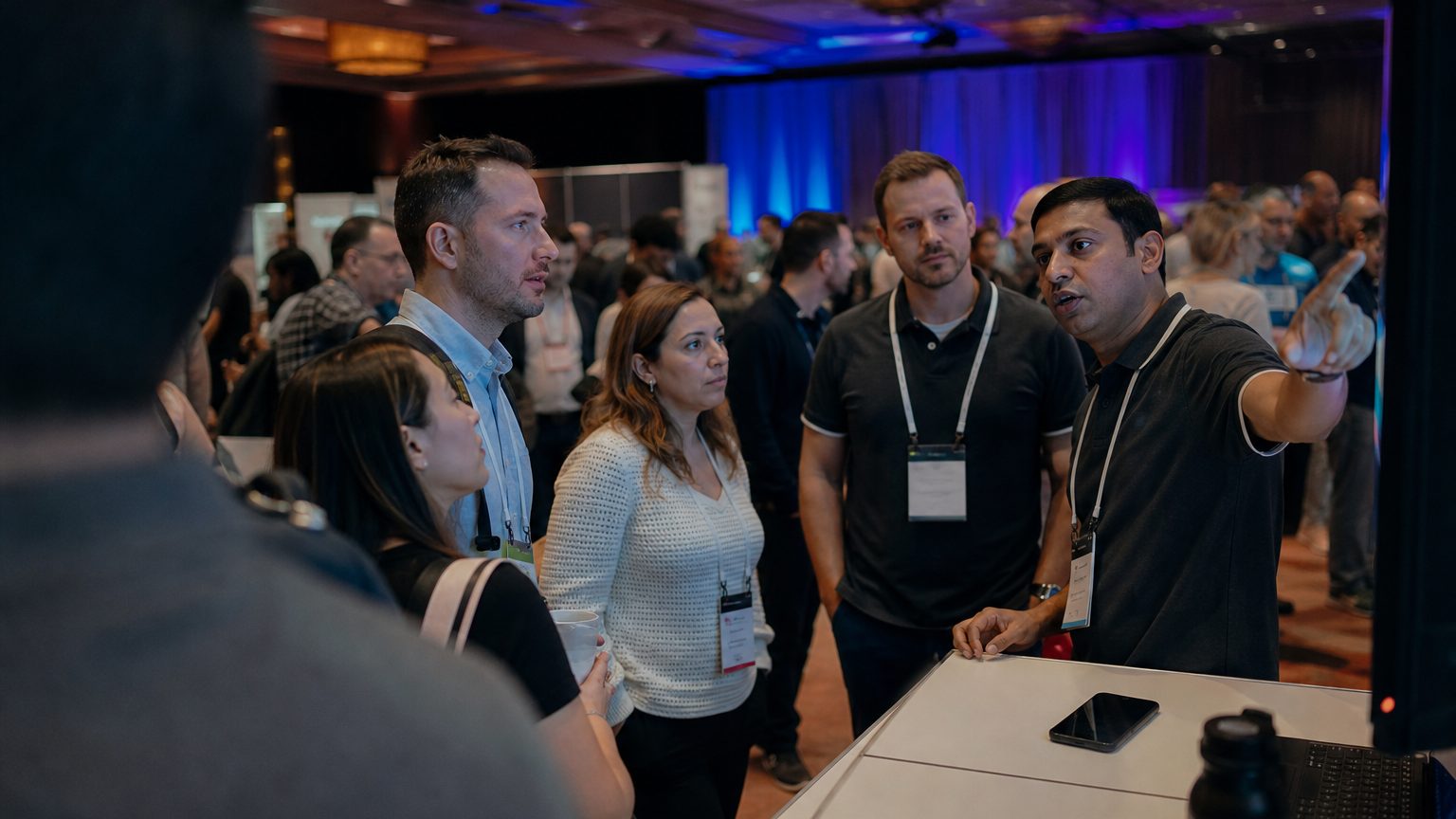
Format: 150-300 attendees, single track, 8:00 a.m. to 5:30 p.m. Think leadership summit, annual all-hands, or an internal function offsite. This is the shape we build for clients running strong, single-day programs when the whole company flies in on Monday and out Tuesday morning.
- 7:30-8:00 Registration + coffee (30 min)
- 8:00-8:20 Welcome + framing session, interactive (20 min)
- 8:20-9:15 Morning keynote: 45 min content + 10 min Q&A (55 min)
- 9:15-9:40 Networking break (25 min)
- 9:40-10:30 Breakout session A (50 min)
- 10:40-11:30 Breakout session B (50 min)
- 11:30-12:15 Panel: leadership Q&A (45 min)
- 12:15-1:30 Lunch, plated (75 min)
- 1:30-3:00 Interactive workshop, small-group format (90 min)
- 3:00-3:25 Break + optional sensory/wellness room open (25 min)
- 3:25-4:15 Fireside chat + audience Q&A (50 min)
- 4:15-5:00 Closing keynote: 35 min + 10 min Q&A (45 min)
- 5:00-5:30 Wrap, next-steps, awards (30 min)
- 6:30 onward Reception offsite
The 1:30 p.m. slot after a plated lunch is the graveyard hour. Do not put a 60-minute lecture there. A workshop, small-group breakout, or anything that gets people out of their chairs will save the afternoon.
Worked example 2: Two-day industry conference with two tracks
Format: 400-800 attendees, two parallel tracks, sponsor expo, evening reception. This is the shape of a mid-sized professional or vertical conference.
Day 1
- 7:30-8:45 Registration + expo hall coffee (75 min, sponsor-owned)
- 8:45-9:05 Welcome + program framing (20 min)
- 9:05-10:00 Opening keynote: 45 min + 10 min Q&A (55 min)
- 10:00-10:30 Networking break in expo hall (30 min)
- 10:30-11:20 Breakouts: Track A / Track B (50 min each, parallel)
- 11:30-12:20 Breakouts: Track A / Track B (50 min each)
- 12:20-1:35 Lunch + sponsor demo theater (75 min)
- 1:35-2:20 Panel: industry outlook (45 min)
- 2:30-3:20 Breakouts: Track A / Track B (50 min each)
- 3:20-3:50 Break in expo hall (30 min)
- 3:50-4:40 Case study sessions: Track A / Track B (50 min)
- 4:40-5:15 Day 1 closing remarks + tomorrow preview (35 min)
- 6:00-9:00 Welcome reception (offsite or expo hall)
Day 2
- 8:00-9:00 Expo hall breakfast (60 min, sponsor-owned)
- 9:00-9:50 Morning keynote (50 min)
- 9:50-10:20 Break (30 min)
- 10:20-11:10 Breakouts (50 min)
- 11:20-12:10 Breakouts (50 min)
- 12:10-1:15 Lunch + awards presentation (65 min)
- 1:15-2:45 Workshop block, choose one (90 min)
- 2:45-3:10 Final break (25 min)
- 3:10-4:00 Closing keynote + call to action (50 min)
- 4:00-4:30 Farewell + CEU/CPE credit distribution (30 min)
The transition between parallel tracks. If Track A ends at 11:20 and Track B ends at 11:22 because the moderator ran long, your 11:30 sessions start at 11:37 and the whole afternoon slides. Give moderators a 5-minute warning card, and put a hard 90-second timer on Q&A close.
Worked example 3: Three-day hybrid conference with on-demand windows
Format: 1,000+ attendees, in-person plus virtual audience across at least two time zones, on-demand content library, CEU/CPE credit tracking. This is where things get complicated, and where nobody in the SERP goes.
Day 1 (in-person launch, virtual joins at scale)
- 8:00-9:00 In-person registration + virtual lobby opens
- 9:00-9:15 Live-streamed welcome, captioned (15 min)
- 9:15-10:00 Opening keynote, live + streamed with captioning (45 min)
- 10:00-10:30 Break (in-person expo; virtual attendees see a 10-min recap loop)
- 10:30-11:20 Breakouts (50 min, three tracks: two in-room, one virtual-native)
- 11:30-12:20 Breakouts (50 min)
- 12:20-1:20 Lunch in-person; virtual on-demand window opens for morning session replays
- 1:20-2:50 Workshop block (90 min, hybrid-capable)
- 2:50-3:15 Break (25 min)
- 3:15-4:05 Panel, live-streamed with virtual Q&A queue (50 min)
- 4:05-4:30 Day 1 close + tomorrow’s virtual-first sessions preview (25 min)
Day 2 (deep programming, virtual-first sessions time-zone stacked)
- Two virtual-native session slots scheduled at 8:00 a.m. and 4:00 p.m. host-local, so EMEA attendees catch the morning and APAC catches the afternoon.
- In-person program: standard two-track day, 9:00 a.m.-5:00 p.m., with a 45-minute prayer/wellness room window at 12:00 and dietary-inclusive lunch stations.
Day 3 (half-day + on-demand handoff)
- 9:00-12:30 closing morning: two breakout slots, closing keynote, farewell.
- 12:30 onward: on-demand library opens for all attendees for 30 days, CEU/CPE credits issued via post-event portal.
Virtual session length. Cut 10 minutes off every in-person block for the virtual-native equivalent. A 50-minute breakout translates to a 40-minute virtual session with a hard 8-minute Q&A cap. Remote fatigue is real and it’s the fastest way to lose the streaming audience by 2 p.m.
Hybrid and virtual agenda adjustments
Nobody in the SERP treats hybrid separately, which is strange given that Skift Meetings has been documenting hybrid as a standing format since 2021. Three rules we hold to when we build hybrid agendas, drawing on how we approach virtual and hybrid programs:
- Shorter sessions for virtual audiences. 40 minutes is the ceiling for streamed keynotes; 30 for breakouts. If you must run the same content live for both, plan the in-room version at 45 min and cut to on-demand for the virtual-native summary.
- Time-zone stacking. Schedule at least two virtual-first sessions per day at hours that work for your second- and third-largest attendee regions. Recording alone is not enough; live attendance drives engagement metrics.
- On-demand windows built into the printed agenda. Don’t hide the replay library in a post-event email. Put it in the agenda as a block so attendees plan around it.
Building accessibility into the agenda
Every top-ranking template misses this entirely. Accessibility is not a footnote; it’s a set of specific time and room decisions you make when the agenda is drafted, not the week before the event.
- Captioning windows. Live captioning needs a 2-minute lead per session for the captioner to sync. Build that into your transition blocks.
- Sensory / wellness / prayer room. Publish the room location and hours on the printed agenda. Ideal: open from registration open to 30 minutes past the last session.
- Dietary blocks. If lunch is served, name the halal, kosher, gluten-free, and vegan stations on the agenda itself so attendees don’t hunt.
- ASL interpretation slots. Confirm which sessions have ASL by name on the agenda, not “available on request.”
- Break length. Some attendees need longer between sessions. A 25-minute break is far more inclusive than a 15-minute one.
Where sponsors and exhibitors fit on the agenda
Sponsors are conference agenda blocks, not stickers you slap on afterward. The templates in the SERP ignore this, which is why so many sponsored sessions get ghost-town attendance.
- Sponsor-owned breakfast or coffee break at the top of the day. 60-75 minutes. The sponsor logo goes on the agenda; the sponsor gets the room energy at peak.
- Demo theater during lunch. 15-20 minute demos on a set schedule inside the expo hall. Print the demo agenda so attendees plan around it.
- Sponsored breakout slot. One per track per day, clearly labeled. Attendees hate stealth-sponsored sessions; label it and let them self-select.
- Expo hall hours built into breaks. Don’t schedule a session against the expo hall closing at 5 p.m. Move the closing session to 4:30 and let the hall stay hot.
The day-of speaker cancellation swap playbook
Asana mentions “last-minute changes” in passing and moves on. Here’s what we actually do when a speaker cancels at 6:47 a.m. on show day.
- Tier 1 (the panel absorb). If the cancellation is a panel seat, don’t replace it. Three panelists is often better than four anyway.
- Tier 2 (the internal backfill). Keep a pre-agreed list of two internal execs or partners who can deliver a 30-minute talk with 24 hours’ notice. Confirmed by name, not “someone will figure it out.”
- Tier 3 (the format swap). Convert the slot into a moderated roundtable or open-mic Q&A. Attendees often rate these higher than the original session.
- Tier 4 (the extended break). Last resort. Extend the surrounding breaks by 15 minutes each and cut the slot. Better than a bad backup.
Every one of these decisions has a swap-agenda already drafted before the event opens. Push the update through your event app by 7:15 a.m., signage by 7:45, verbal from the emcee at the top of the next general session.
Formats to ship: Sheets, Excel, Word, Notion, PDF
The templates worth downloading come in the format your team already uses. Google Sheets for the run-of-show working doc. Excel for the finance and F&B reconciliation. Word for the attendee-facing program. Notion for the internal team wiki. PDF for print and signage.
One version does not fit all. If your template only exists as a proprietary tool view (Asana, Confluence), you’ll spend the week before show export-hacking it into something the AV team can actually use. Build the agenda in Sheets first, then port it out.
Talk to us
If you’re building the agenda for a 2027 conference, sales kickoff, or hybrid program and you’d rather not reinvent the run-of-show from scratch, we’ve done the work. We plan conferences and multi-day meetings across every format above, and we’re happy to share the working templates we hand our own clients. Get in touch and we’ll walk through it.