Pull 400 people out of their day for a 60-minute all-hands and you have committed a meaningful slice of your payroll to one hour of listening, before anyone touches the AV invoice. Nobody says that part out loud. The company-wide meeting gets treated like a free ritual, a warm thing you do because good companies do it, when it is quietly one of the most expensive recurring items on the calendar.
That framing matters, because a meeting you treat as free is a meeting nobody protects from bloat. We have sat in the back of enough all-hands to watch a genuinely useful 30-minute update balloon into 75 minutes of department slide decks that could have been a Slack post. The benefits below are real. They are also conditional. You earn them by treating the meeting as an investment with a return you can name.
So here is the honest version: what company-wide meetings are actually good for, why so many of them get rated as wasted time, a timed run-of-show you can steal, a framework for delivering bad news to the whole company, and how to tell afterward whether any of it worked.
What a company-wide meeting is actually good for
An all-hands (company-wide, town hall, whatever your culture calls it) is the one recurring moment your entire org is pointed at the same thing at the same time. That single property is the whole value. Everything below flows from it.
Alignment beats information
The biggest misuse of an all-hands is treating it as a broadcast channel. Status updates, numbers, roadmaps: most of that belongs in a doc people read on their own time. What a live gathering does that a doc cannot is create shared context in real time, so the sales team hears the same “why” behind the reorg that engineering hears, in the same words, in the same minute. That is alignment, and it is worth the room. A dashboard emailed at 5 p.m. is not.
Trust, which most orgs are quietly short on
Here is the number that should shape your agenda. Gallup’s research on engagement ties highly engaged business units to 21% higher profitability and 43% lower turnover than their least-engaged counterparts, and Gallup has also found that only about one in four employees strongly agrees they trust the leadership of their organization. Trust is not built by a polished keynote. It is built by leadership answering a question they did not pre-screen, in front of everyone, and not flinching. Which is why the Q&A block later in this article is not the optional dessert course.
The case for face-to-face, occasionally
Not every all-hands needs a venue. The in-person version does something a video grid does not. SITE, the Society for Incentive Travel Excellence, consistently finds that in-person connection drives loyalty and cross-team collaboration in ways virtual formats struggle to match, which is exactly why companies still fly people into Chicago or Austin for the meeting that actually matters. MPI’s Meetings Outlook research has tracked the same pattern through the return-to-live cycle: the business case for gathering holds up when the gathering has a job to do. When we plan the once-a-year in-person all-hands as part of a larger program, we run it with the same discipline as any multi-day event, the approach we bring to conferences and larger meeting programs. The other ten meetings a year can live on a screen without apology.
Watch out for: the executive who wants the in-person all-hands because the last one “felt great,” with no agenda attached. Good feeling is an output, not a reason. If the only thing on the run-of-show is a state-of-the-company deck, you have booked travel for a webinar.
The uncomfortable part: all-hands meetings are frequently rated a waste
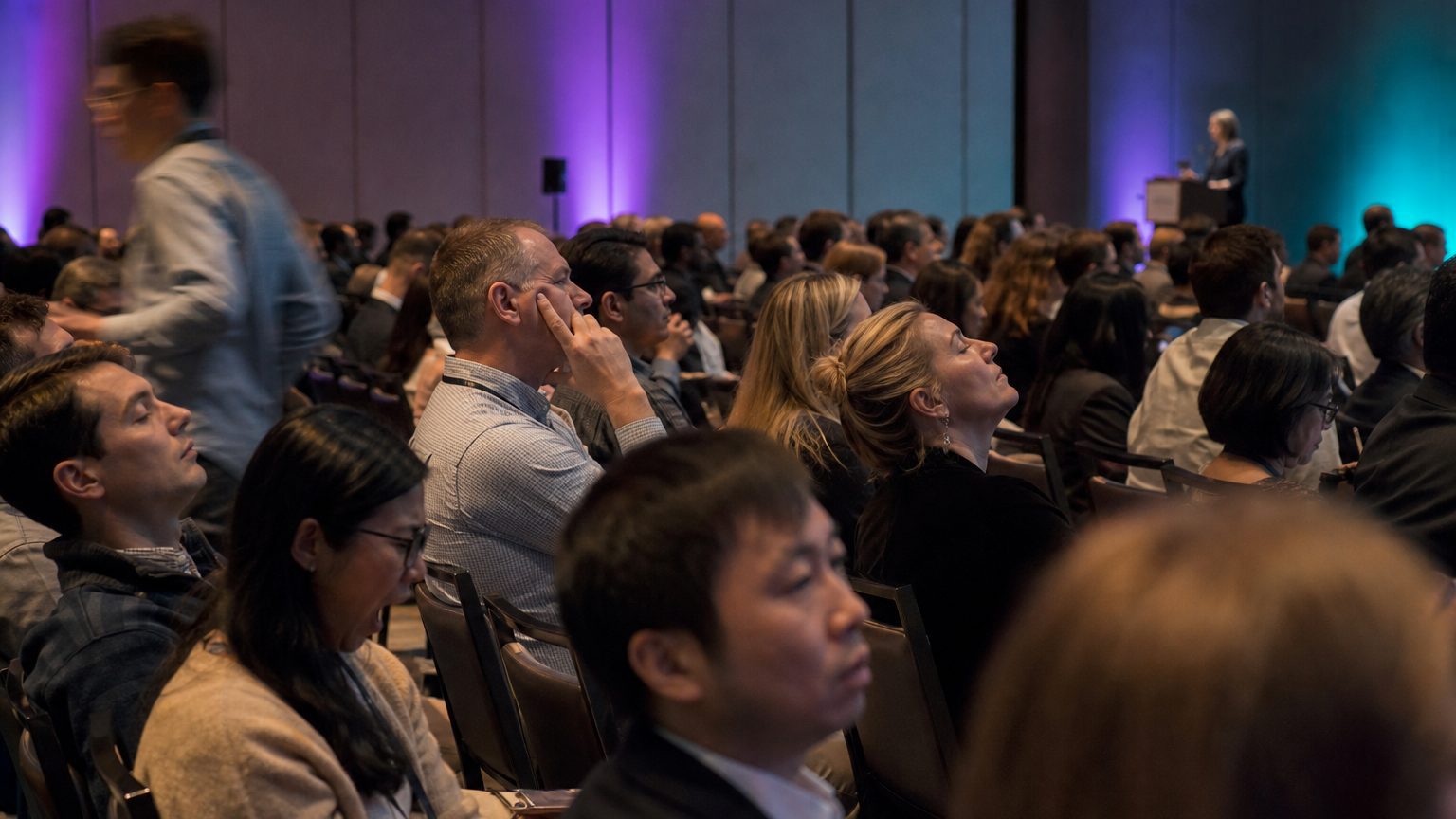
Ask employees to name the meeting they would happily delete and the company-wide gathering lands near the top. Survey work on meeting waste routinely puts town halls and all-hands in the top two or three most-cited unproductive formats, with something close to half of respondents saying so. Meanwhile the broader cost of poorly run meetings gets measured in hundreds of billions annually across the U.S. economy, and the average knowledge worker loses the equivalent of several full work weeks a year to meetings that produced nothing.
Both things are true at once: the format has real upside, and the median execution of it is bad. That gap is the whole opportunity. Nearly every failure we see traces to one of four causes.
- One-way broadcast — Symptom: 55 minutes of slides, 5 minutes of “any questions?” · Fix: cap presentation at 60% of the clock
- Agenda by department queue — Symptom: every team gets a turn regardless of news · Fix: one deep dive per meeting, rotated
- Cadence outrunning content — Symptom: padding to fill the hour · Fix: lengthen the interval, not the agenda
- No accountability loop — Symptom: nobody remembers last month’s commitments · Fix: published action log with named owners
Cadence: a decision matrix by company size and stage
Common advice says pick a cadence and hold it sacred. That is backwards. Cadence should follow information density, not the reverse. If your bi-weekly all-hands routinely pads to fill the hour, you do not have a bi-weekly amount of news. You have a monthly amount of news and a bi-weekly calendar hold.
- Under 50 people, early stage — Cadence: weekly or bi-weekly · Length: 20-30 min · Rationale: strategy changes fast and everyone is close enough to the decision to need it live
- 50-250 people, scaling — Cadence: monthly · Length: 45-50 min · Rationale: silos are forming, so the meeting’s job shifts from updates to cross-team context
- 250-1,000 people, mid-market — Cadence: monthly or every six weeks · Length: 50 min · Rationale: the time cost is now real money, and async updates can carry routine news
- 1,000+ people, enterprise — Cadence: quarterly company-wide, monthly by division · Length: 60 min · Rationale: one voice for everyone quarterly, with regional and functional town halls doing the detailed work in between
Watch out for: the meeting nobody can cancel. Once an all-hands sits on a fixed cadence it develops a survival instinct, running whether there is a reason or not, because canceling feels like a signal. Give the CEO permission to skip one. The over-meeting instinct corrects itself fast when the recurring hold has a stated purpose test attached to it.
A minute-by-minute run-of-show for a 50-minute all-hands
“Set a clear agenda” is advice that has never once ended a meeting on time. Here is a real one, sized for a 50 to 500 person company. Steal it.
- 0:00 – 0:03 — Open and frame. The moderator, not necessarily the CEO, names the one thing this meeting is about. No housekeeping. No reading the agenda aloud.
- 0:03 – 0:12 — Business update. Leadership on numbers and direction. Nine minutes, hard stop. Detail lives in a linked doc published the morning of.
- 0:12 – 0:24 — One deep dive. A single team, product, or customer story with substance. Rotate who gets it. One topic, not five.
- 0:24 – 0:31 — Recognition. Two or three specific callouts with the actual work described. “Thanks to everyone in support” recognizes nobody.
- 0:31 – 0:46 — Live Q&A. Fifteen minutes, upvoted questions from a tool like Slido, hardest question first. Yes, first.
- 0:46 – 0:50 — Close and commitments. Moderator restates decisions made and the two or three things landing before the next meeting.
Notice the shape: 30% of the clock is two-way. That ratio is the difference between a meeting people attend and a meeting people mute.
Watch out for: the pre-screened Q&A that only surfaces comfortable questions. Employees can spot a planted question from three rows back, and a fake Q&A costs more trust than no Q&A at all. Take the upvoted list as it comes, and if the top question is about headcount, answer the one about headcount.
How to run a company-wide meeting on difficult news
Layoffs, a missed quarter, a strategy reversal, an acquisition nobody saw coming. This is the meeting that defines how people remember your leadership, and it is the one most often handled badly. A structure that holds up:
Lead with the news in the first 90 seconds
No warm-up, no quarterly highlights, no “before we get to that.” Everyone in the room already knows something is coming, and burying the announcement at minute 20 reads as cowardice. State what happened, what it means, and who is affected, in that order, immediately.
Separate the announcement from the processing
Do not try to deliver hard news and run an open floor in the same 45 minutes. People need time to react before they can ask anything useful. The pattern that works: a short all-company announcement, then manager-led team conversations within two hours, then a full company Q&A 24 to 48 hours later once the real questions have formed.
Say what you do not know
“We have not decided that yet, and I will tell you the week we do” is a credible answer. Improvised reassurance you cannot keep is not. Track every unanswered question in a visible doc and close each one publicly, even when the answer is unwelcome.
Watch out for: the hybrid version of a hard announcement where remote staff learn the news from a laggy stream while the head office hears it in person. Either everyone joins from their own screen, or you send the written version at the same moment the room hears it. The HBR guidance on crisis communication is blunt on this point: inconsistent timing across audiences reads as favoritism, and it is remembered longer than the news itself.
The follow-up framework: what happens in the 30 days after
The meeting is the cheap part. The follow-up is where the value either compounds or evaporates, and it is the step most companies skip entirely.
- Within 24 hours — Recap email with the recording, the linked detail doc, and answers to questions that ran out of clock
- Within 48 hours — Action log published, every item with a named owner and a date, visible to the whole company
- Within one week — Manager-led team debriefs: what did this mean for us specifically, what changes on Monday
- At 30 days — Pulse check on two or three questions, plus a public status pass on the action log before the next meeting
The action log is the item worth fighting for. It converts an all-hands from a broadcast into a commitment device, and after two or three cycles of leadership publicly closing items, question quality rises noticeably. People ask real things when they believe the answers get tracked.
How to measure whether your all-hands is working
You do not need an analytics practice. Four numbers, tracked monthly, tell you almost everything:
- Live attendance rate — Target: 80%+ of eligible staff · Signal: if it slides below 60%, the meeting has lost its reason to exist
- Q&A participation — Target: questions from 10%+ of attendees · Signal: falling submissions mean people stopped believing answers are honest
- Post-meeting pulse score — Target: one question, “I left with a clearer picture of where we are heading,” 4+ out of 5 · Signal: track the trend line, not the absolute
- Action-item completion — Target: 80% closed before the next meeting · Signal: the single best predictor of whether people take the format seriously
Watch out for: measuring satisfaction instead of clarity. “Did you enjoy the meeting?” produces flattering numbers and tells you nothing. Ask whether people can now explain the company’s priorities to a friend. That is the outcome you are buying.
Planning the once-a-year in-person version for 2027 and 2028
The annual in-person all-hands is a different animal, and it deserves real lead time. For a 2027 program we start conversations 9 to 12 months out, and for anything landing in first-quarter 2028, earlier still, because January and February compete directly with sales kickoff season for the same ballrooms in Nashville, Scottsdale, and Orlando. Skift Meetings has tracked how tight group demand and compressed hotel availability have stayed through recent cycles, and that pressure lands hardest on groups that go to market late with a fixed date.
Two operator moves that consistently pay off. First, hold flexible dates as long as you can: shifting a Monday start to a Sunday arrival has repeatedly let us negotiate F&B minimums down double digits for the same program. Second, build the content backward from the meeting’s purpose rather than forward from the room. We have watched teams book a 600-person ballroom and then discover the actual goal, cross-functional problem solving, needed eight breakout rooms and a plenary half that size. Our team has planned enough of these to be opinionated about the sequence, and you can read more about how we work if you want the longer version.
One last thing to guard against: the annual in-person all-hands that quietly becomes an incentive trip with a slide deck stapled to the front. Both are legitimate programs. They have different goals, different audiences, and different measures of success, and blending them usually shortchanges each.
If you are scoping a company-wide meeting for 2027, whether it is a monthly virtual all-hands that needs tighter production or an annual in-person gathering for several hundred people, we are happy to talk through the format before you sign anything. Bring us the goal and the headcount and we will tell you honestly what the meeting needs to accomplish it. Get in touch with our team and we will start with the agenda, not the ballroom.