Most posts about the meeting kick off will tell you to cover the 5 Ws, invite the right people, and end with next steps. Fine, as far as it goes. It also describes roughly every meeting ever held, which is why so many kickoffs end with a group of smart people nodding, going back to their desks, and quietly disagreeing about scope for the next six weeks.
For the full playbook, see our services guide.
The wedge is not another definition. It is the artifacts: a timeboxed agenda you can actually run, an invite that makes people prepare, a RACI grid nobody has to redraw, remote facilitation tactics that survive contact with cameras-off culture, and the metrics that tell you within 48 hours whether the meeting worked. That is what this piece ships.
One caveat before we start. Kickoffs are not one thing. A project kickoff, a sales kickoff, an annual company kickoff, and a client-onboarding kickoff share about 30% of their DNA and diverge sharply on the rest. We will get to the comparison. First, the agenda most people need.
The 60-minute kickoff agenda, minute by minute
The default should be 60 minutes, not 90. Research on meeting effectiveness has been pointing this way for years. Harvard Business Review’s work on meeting overload and Bain’s widely-cited seven-person rule both push toward smaller, tighter meetings. Add people and add time and you add exponential drag on decisions. Book 60. If you actually need 90, you have a scope problem the kickoff will not solve.
0-5 min: Land the plane, not the small talk
Open with the outcome of the meeting itself, in one sentence. “By 3pm we will have agreed on scope, named the RACI, and locked the first three milestones.” Then read the agenda out loud. Five minutes. Do not do a 15-minute round of “tell us your name and your favorite ice cream.” You are burning the room’s most alert five minutes on nothing.
5-15 min: The why, in the sponsor’s voice
The executive sponsor, or the closest thing to one, states the business reason this work exists and what changes if it succeeds. Ten minutes, not thirty. If the sponsor cannot articulate the why in ten minutes, the project has a bigger problem than the kickoff. This slot is where PMI’s Pulse of the Profession research keeps landing: projects tied to a clear strategic priority succeed at meaningfully higher rates than those that are not.
15-30 min: Scope, in plain language
Fifteen minutes on what is in and, more importantly, what is out. The Standish Group’s CHAOS Report has been beating the drum on scope-related failure for decades. Unclear or shifting scope is one of the most persistent predictors of trouble. Write the out-of-scope list on the shared doc while people watch. That list is often more useful than the in-scope one.
30-45 min: Roles and the RACI
Walk the RACI grid on screen. Every deliverable has exactly one Accountable. If two names show up in the A column, you have not finished the conversation. Fifteen minutes is enough if you did the pre-read. It is not enough if you did not, which is why the pre-read exists.
45-55 min: Milestones and first three actions
Skip the full timeline. Nobody remembers a Gantt chart from a kickoff. Lock the next three milestones with dates and owners. That is what gets carried into the follow-up email.
55-60 min: Parking lot and close
Five minutes for the questions that did not fit. Anything unresolved goes into a parking lot with a name and a due date. Close by restating the three milestones and their owners. Done.
The invite email that actually gets people to prepare
The invite is the pre-work. If it reads like a calendar hold, you will get a room full of people improvising. Use this structure:
- Subject: [Project Name] Kickoff, Tues 10am, 60 min, pre-read required
- Outcome: One sentence on what we will decide by end of meeting.
- Pre-read: Two links, max. The project brief and the draft RACI. Ten minutes of reading, not thirty.
- Ask: “Come with one thing you would flag as a risk and one open question about scope.”
- Agenda: Paste the timeboxed agenda from above. Do not attach it as a PDF nobody opens.
The “come with one risk and one question” line is doing a lot of work. It signals that the meeting is participatory, not a briefing. It gives introverts a fair shot. And it lets you skip the awkward “any questions?” silence at minute 47.
Kickoff types compared: project vs. sales vs. annual vs. client onboarding
They are related but the shape is different.
| Type | Duration | Audience | Primary output | Watch out for |
|---|---|---|---|---|
| Project kickoff | 60-90 min | Core team, 7-10 people | Scope, RACI, first 3 milestones | Inviting too many stakeholders and losing decision speed |
| Sales kickoff (SKO) | 2-3 days | Full sales org plus enablement | Number, territory, motion, product story | Death by breakout; not enough time to actually role-play the pitch |
| Annual company kickoff | Half-day to 2 days | All-hands or department-wide | Priorities, org changes, cultural reset | Reading slide decks aloud instead of running working sessions |
| Client-onboarding kickoff | 60 min | Client execs plus your delivery team | Success criteria, comms cadence, escalation path | Skipping the escalation conversation because it feels awkward |
The multi-day formats, SKOs and annual kickoffs, are their own animal. If you are scoping one of those, the timeboxed 60-minute agenda above is the wrong tool. That is where a proper program design comes in, and it is worth reading through how we approach sales kickoff planning before you start building the run of show.
The remote and hybrid kickoff playbook
Remote kickoffs fail differently than in-person ones. In-person, the failure mode is usually a scope conversation that runs long. Remote, the failure mode is that half the room never really shows up. Cameras off, second monitor on Slack, nodding into the void.
Most posts about the meeting kick off will tell you to cover the 5 Ws, invite the right people, and end with next steps.
Async pre-read via Loom, not a doc dump
Record a five-minute Loom of the sponsor walking the why. People will actually watch a five-minute video. They will not read a nine-page PDF. Send the Loom with the invite and reference it in the meeting: “You saw the Loom, so I will not repeat the why. Questions on it?”
Camera-on norm, but only for the parts that need it
Do not fight the whole “cameras on” war. Pick your spots. Cameras on for intros and the scope conversation. Cameras optional during the RACI walk-through where people are actually looking at a shared doc. This is more honest about how people work and gets you better engagement in the moments that matter.
Breakout rooms for scope questions, not for icebreakers
Split into rooms of three for ten minutes when the scope conversation gets sticky. Small groups will surface disagreements the big room politely swallows. Bring the disagreements back. Icebreakers in breakouts, on the other hand, tend to produce polite chitchat and no useful signal.
Miro or FigJam for the risk brainstorm
Sticky-note risks on a shared board for five minutes, then cluster and rank. Everyone contributes at once, which is the one genuine advantage remote has over in-person. Use it.
The RACI snippet you should be handing out
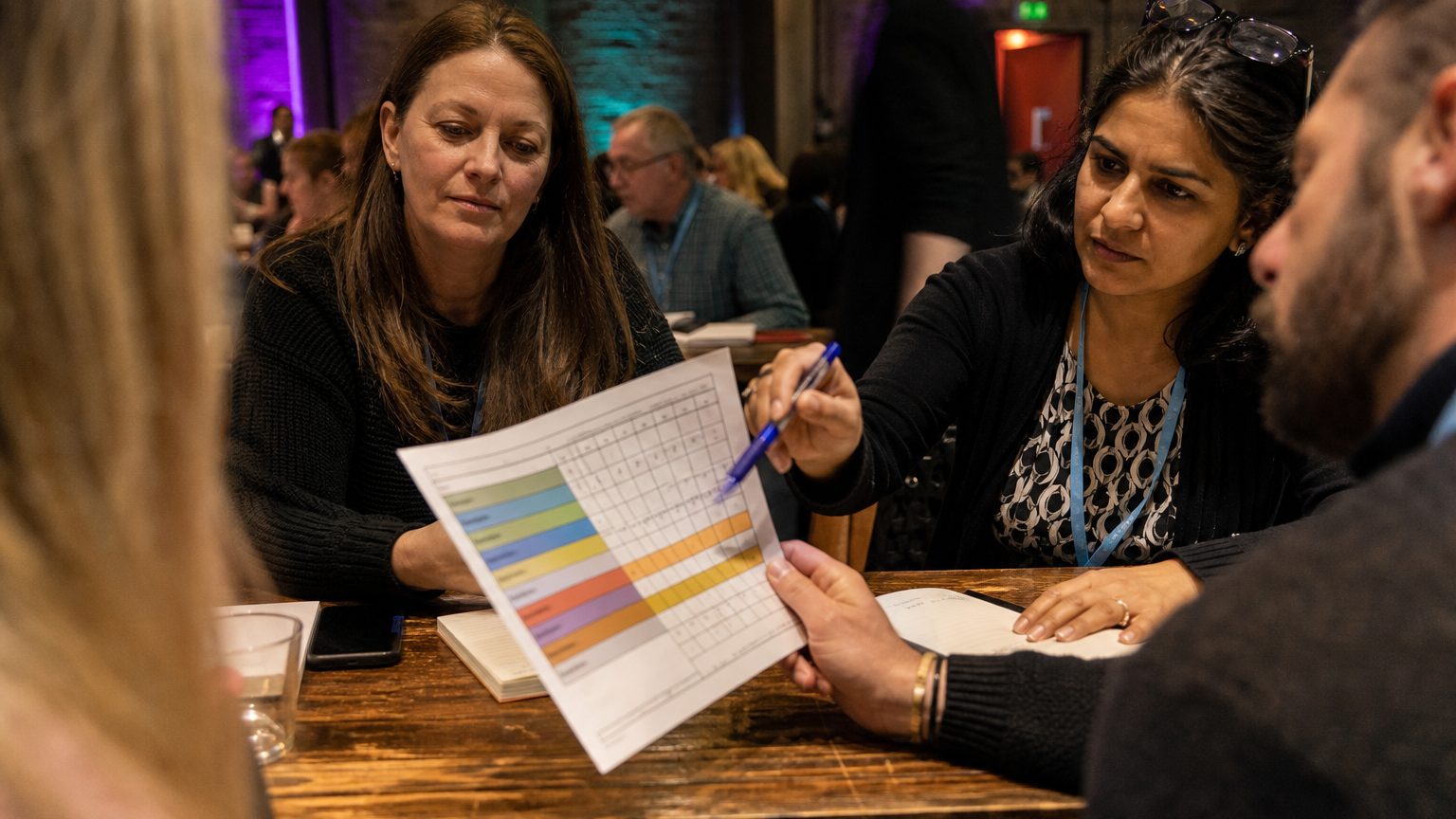
A full RACI for a real project is 30-50 rows. Nobody reads that in a kickoff. Bring a 6-8 row version covering only the top deliverables. Example rows for a product launch:
- Launch positioning doc: PMM (A), Product (R), Sales leadership (C), Support (I)
- Pricing sign-off: Finance (A), PMM (R), CEO (C), Sales (I)
- Enablement session: Sales enablement (A), PMM (R), Product (C), CSMs (I)
The rule is one Accountable per row. If you cannot get to one A, you have not finished the conversation about who owns the outcome. That is not a documentation problem, it is a decision problem, and the kickoff is the place to solve it.
How to measure whether your kickoff worked
Here are three concrete measures we use.
Action-item completion rate at 48 hours
Every action item leaves the meeting with an owner and a due date. Forty-eight hours later, count how many are done or visibly in progress. Under 60%, and your kickoff generated agreement but not momentum. That usually means owners were assigned in the room without their real buy-in.
Post-meeting alignment survey
Two questions, sent within an hour of the meeting. “In one sentence, what is the goal of this project?” and “Name one thing that is out of scope.” If answers diverge, you did not align. You had a nice meeting.
Time to first deliverable
Track how long it takes to ship the first named milestone. A well-run kickoff shortens time-to-first-deliverable versus your team’s baseline. If it does not, the kickoff is theater. Google’s re:Work research on team effectiveness keeps coming back to the same pattern: clarity of role and goal is the biggest lever, and it is measurable in output speed.
The 48-hour follow-up recap template
Send within 24 hours, ideally same day. Keep it under 200 words. Structure:
- Decisions made: Three to five bullets. Not “discussed,” not “reviewed.” Decisions.
- Owners and dates: The first three milestones with names and dates.
- Parking lot: Open questions with an owner and a date by which they will be resolved.
- Next meeting: When and what will be decided there.
The line to cut is any restatement of the why. Everyone was in the meeting. They know why. Restating it is a tell that you do not have anything concrete to report.
Where kickoffs go sideways (and what to do about it)
A few failure modes we have watched play out more times than we would like:
The invisible sponsor. Sponsor sends a delegate, delegate cannot make decisions, room defers everything to “check with [sponsor].” Fix: refuse to run the kickoff without the sponsor in the room for at least the first 20 minutes. Reschedule if you have to. This one is worth the political cost.
The 22-person invite list. Someone from every stakeholder team, plus their manager, plus a note-taker. Nobody talks because nobody knows if it is their turn. Fix: two rooms. Core decision-makers in the kickoff, everyone else in a 30-minute readout the next day. The Bain seven-person rule exists for a reason.
The soft close. “Great meeting everyone, we’ll follow up on next steps.” No dates, no owners. Fix: the last five minutes are non-negotiable. Names and dates on screen before anyone leaves.
The scope creep smile. Someone floats an addition. Everyone nods politely. It ends up in the scope by osmosis. Fix: any scope change goes to the parking lot with a name and a decision date. “Interesting, that is a parking lot item. Who owns getting us to a yes or no by Friday?”
Ready to run a better kickoff?
If you are scoping a project kickoff, a small ritual and a good template will get you 80% of the way. If you are scoping a sales kickoff, an annual company kickoff, or a client-facing program that involves travel, catering, or a stage, that is a different job with different failure modes. That is the work we do. Come talk to our team about scoping a 2027 program, or take a look at everything we have learned about incentive travel if the audience is your top performers rather than your project team.
Further reading
For more on this topic, the Meeting Professionals International is a trusted industry resource for meeting planning standards and event industry research.