
Most of the incentive travel RFP templates floating around the internet were built for meetings. Six sections, a budget line, an evaluation paragraph, done. That’s fine if you’re sourcing a sales training for 80 people in Dallas. It’s not fine if you’re sending 220 qualifiers and their guests to Los Cabos with a room-gift program, a CSR afternoon, and a closing-night beach dinner that needs a Plan B in case the wind picks up.
The wedge in a good incentive RFP is specificity. Real numbers in the budget. Real qualifier counts and tier breakdowns. Real contract language on attrition, force majeure, and U.S. tax treatment. A weighted scorecard so you can defend the award internally when the CFO asks why you didn’t pick the cheapest bid.
What follows is the template we use, the benchmarks we anchor it to, and the failure modes we’ve watched other planners walk into. Take what’s useful, ignore what isn’t, and adapt the language to your program.
Why a generic meeting RFP fails for incentive programs
A meeting is a cost center the business is trying to run efficiently. An incentive is a revenue lever the business is trying to make memorable. Those two things produce very different RFPs, and treating them as interchangeable is the single most common reason proposals come back impossible to compare.
The IRF’s Incentive Travel Index has consistently shown that buyers prioritize unique experiences, destination appeal, and qualifier engagement over raw cost-per-head. A meeting RFP that asks “What’s your daily delegate rate?” doesn’t surface any of that. You’ll get six bids, all within 8% of each other on price, and zero insight into who can actually design a program your top performers will talk about for two years.
Incentive RFPs need a different scope: qualifier communications, gifting strategy, room gifts and amenity drops, optional activities, spousal and guest policies, CSR components, sustainability reporting, and air block management. Inventive’s template lumps meetings and incentives together. Don’t. Separate them, and you’ll save yourself a round of clarification calls.
RFPs that don’t specify whether spouses/guests are included. We’ve seen quotes come back $1,800 per person off because one bidder assumed singles and another assumed doubles. Spell it out in the attendee profile section.

The core sections every incentive travel RFP needs
Strip away the formatting and an incentive travel RFP template comes down to nine sections. Skip any of these and you’ll pay for it later in clarification emails, scope creep, or a contract you can’t defend to procurement.
- Program overview and objectives. What is the program rewarding? Top 10% of sales? Channel partners? New-logo hunters? Name the audience and the business outcome.
- Attendee profile. Qualifier count, guest count, expected demographic split, accessibility needs, dietary patterns, average tenure. SITE’s research on attendee expectations underscores how much program design hinges on this.
- Destination criteria or shortlist. Either name 2-4 destinations or define the criteria (region, flight time from major hubs, weather window, brand fit).
- Program dates and flexibility. Primary dates, backup dates, blackout dates, and whether you can shift to a shoulder week to capture pricing.
- Scope of services. Air, ground, hotel, F&B, activities, gifting, communications, registration tech, on-site staffing, post-program reporting.
- Budget and pricing format. A target per-person range and a required cost-breakdown structure so bids are comparable.
- Contract terms. Attrition, cancellation, force majeure, deposit schedule, payment terms.
- Evaluation criteria. The weighted rubric you’ll use to score responses.
- Timeline and submission requirements. Q&A deadline, response due date, finalist presentations, award date, contract signature target.
If you want to compare destinations apples-to-apples before you write the brief, our destination finder tool lets you filter by air lift, seasonality, and budget tier in about ten minutes.
Per-person budget benchmarks by destination tier
The number one thing missing from every competitor template we reviewed: actual dollar figures. “Budget” as a section header with a blank line under it is not a budget section.
The IRF Incentive Travel Index has reported average per-qualifier spend in the $4,000 to $7,000+ range, with high-end programs pushing well past $10,000 once air, gifting, and guest costs are loaded in. SITE Index data has shown the Caribbean, Mexico, and Hawaii continuing to dominate North American program selection, with Europe rising as the qualifier bar gets higher.
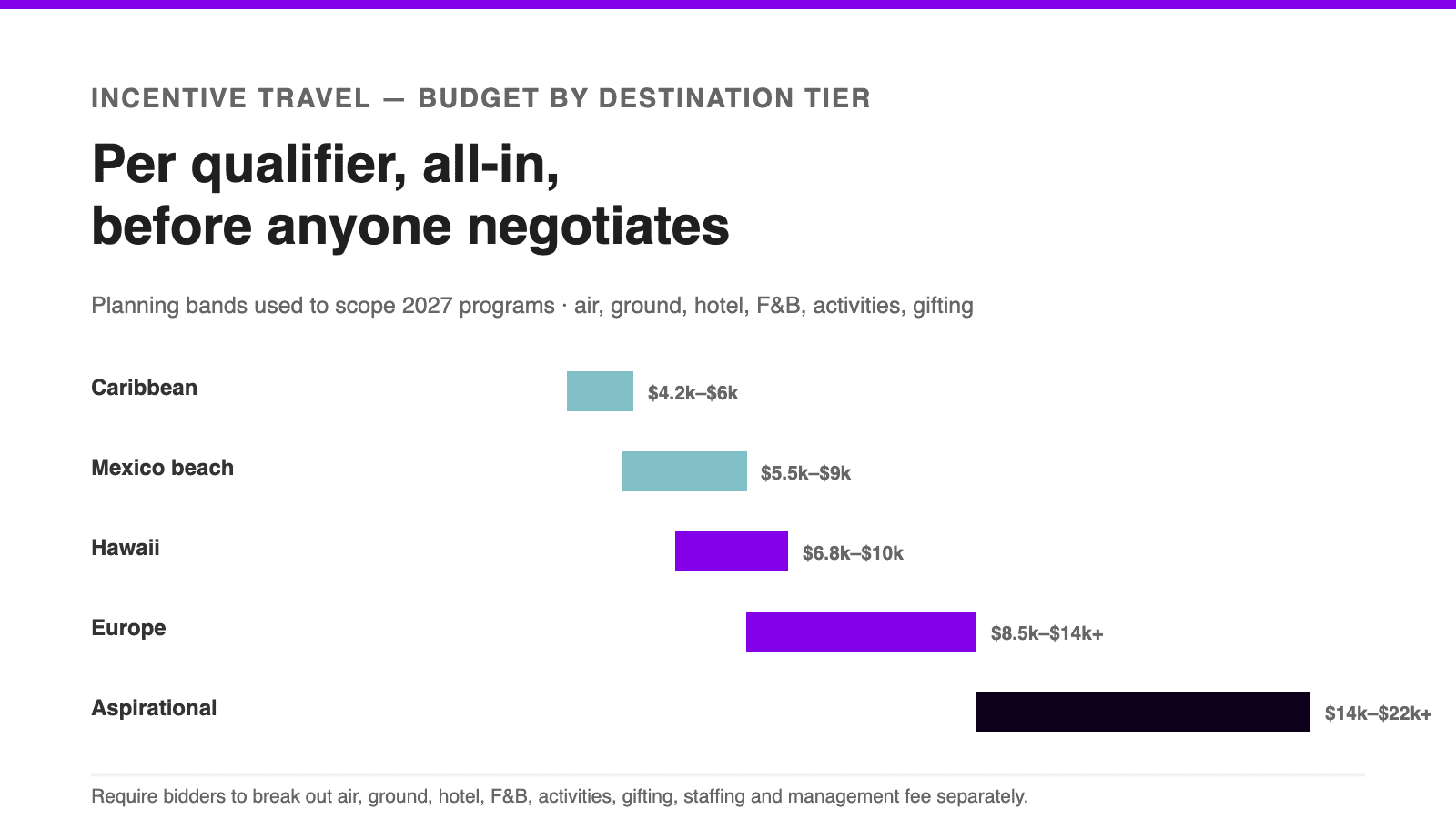
Rough 2027 planning benchmarks we use when scoping:
| Destination tier | Per qualifier, all-in | What moves the number |
|---|---|---|
| Caribbean 4-night all-inclusive |
$4,200–$5,800 | Air origin is the main swing. |
| Mexico beach Los Cabos, Riviera Nayarit, Punta Mita |
$5,500–$8,500 | Top-tier resorts push the ceiling. |
| Hawaii Maui, Big Island |
$6,800–$9,500 | East Coast air and resort fees eat the spread. |
| Europe Lisbon, Mallorca, Tuscany, Lake Como |
$8,500–$14,000+ | Air class policy and whether you charter ground. |
| Aspirational Maldives, Bora Bora, safari |
$14,000–$22,000+ | Top-of-house programs only. |
Build a target range into the RFP and require bidders to break out air, ground, hotel, F&B, activities, gifting, staffing, and management fee separately. If a bid arrives as a single bundled per-person number, send it back.
Hotel vs. DMC vs. full-service incentive house: three RFP variants
One of the worst things you can do is send the same RFP to a hotel sales manager, a destination management company, and a full-service incentive house. They’re selling different things, and the bids will be impossible to compare.
Hotel RFP. Short. Room block by night and category, F&B minimum, meeting space, comp ratio, attrition, cancellation, concessions (welcome amenity, suite upgrades, resort fee waivers). Cvent’s sourcing data has shown hotel RFP response rates climbing back since 2023, but custom incentive asks still get deprioritized behind standard corporate group business. Keep the ask tight.
DMC RFP. Ground transportation, off-property events, activities, staffing, local vendor management, permits, security. DMCs don’t sell hotel rooms. Don’t ask them to.
Full-service incentive house RFP. Everything. Program design, hotel sourcing and contracting, air, ground, registration, qualifier communications, gifting, on-site management, reconciliation, post-program reporting. This is what most planners actually need and what we spend most of our time doing.
Asking a DMC for a “turnkey program” when they don’t book hotel rooms or manage air. You’ll get a polite no or, worse, a yes followed by a scramble when the actual scope becomes clear.
Tax, attrition, and force majeure clauses to include
The clauses nobody wants to write are the ones that save the program when something goes sideways. Three to include in every incentive travel RFP:
U.S. tax treatment of trip value. Per IRS guidance (see Publication 15-B on fringe benefits and Publication 535 on business expenses), the fair market value of an incentive trip awarded to an employee qualifier is generally taxable compensation and reportable on the W-2. For non-employee channel partners or dealers, it typically falls under 1099 reporting. Many programs gross up to cover the tax hit. Ask the bidder how they handle FMV calculation and reporting support. If they look at you blankly, that’s your answer.
Attrition. MPI Meetings Outlook surveys have repeatedly flagged attrition clauses as one of the most contested contract terms post-2020. Push for a sliding scale tied to cut-off date, not a flat 80%. We’ve negotiated attrition down to 70% with a 60-day cut-off on properties that were hungry for the business.
Force majeure. Post-pandemic language is no longer optional. Specifically name: government-issued travel restrictions, declared public health emergencies, natural disasters, and acts of terrorism. Include a refund-of-deposits provision, not just a rebooking credit.
Deposit schedule. Standard incentive contracts ask for 25-50% upfront. Negotiate a tiered deposit (10% at signing, 25% at 180 days, balance at 30 days) and you free up working capital for the rest of the program.
A weighted scoring rubric for incentive RFP responses
If you can’t defend the award decision on a scorecard, procurement will eventually force the decision into a spreadsheet you didn’t design. Build the scorecard before you send the RFP.
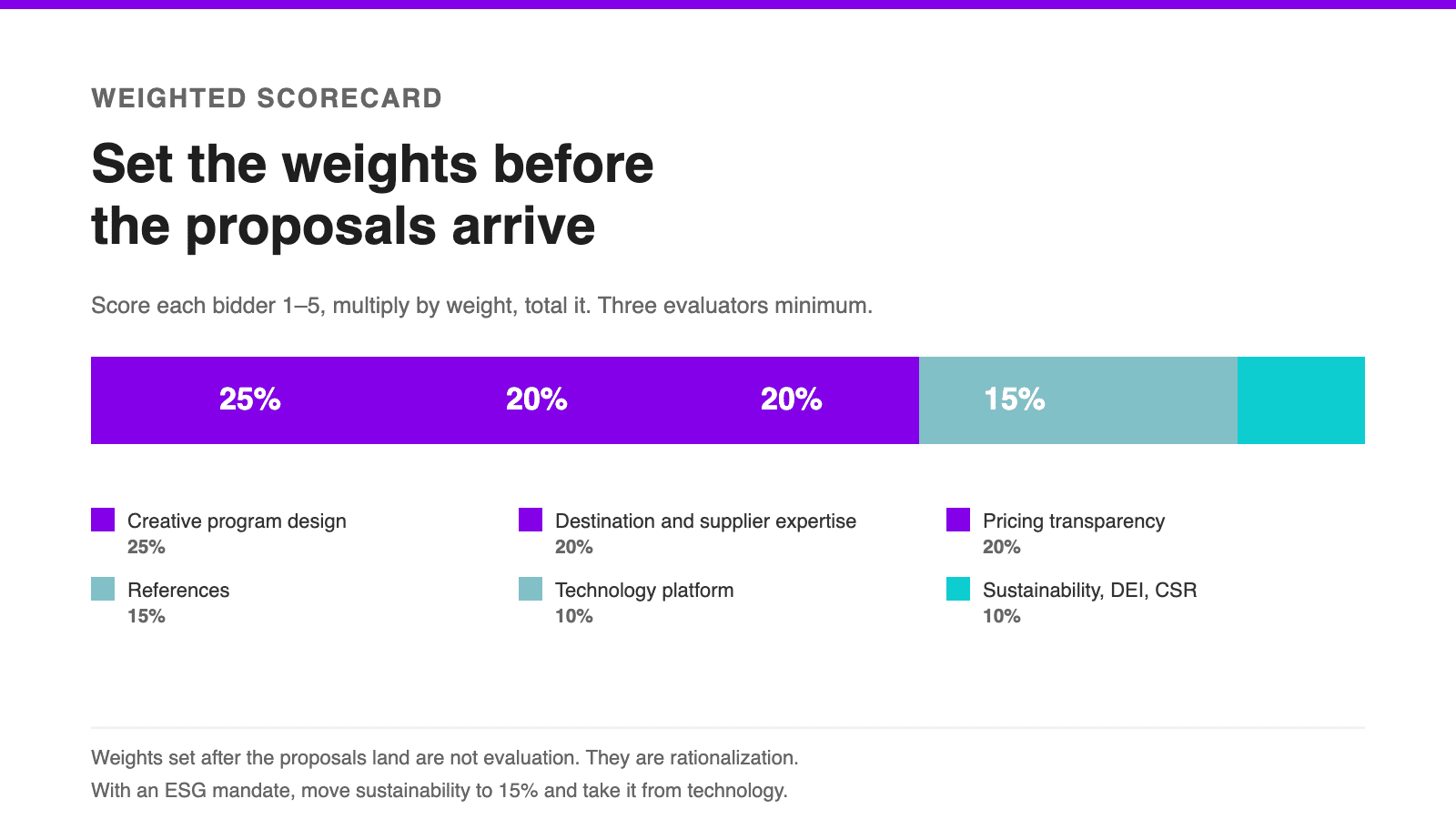
The weighting we use most often:
| Criterion | Weight | What you are actually scoring |
|---|---|---|
| Creative program design and qualifier experience | 25% | Does it feel distinct, or is it a stock itinerary with the dates swapped? |
| Destination and supplier expertise | 20% | Programs run at the proposed property in the last 24 months. Current GM and group sales contacts. |
| Pricing transparency and value | 20% | Cost broken out by category, no buried management fee, assumptions documented. |
| References from comparable programs | 15% | Same size, same audience type, same destination tier. Generic references do not count. |
| Technology and registration platform | 10% | Platform, mobile app, reporting dashboard, data security posture. |
| Sustainability, DEI, and CSR capability | 10% | Push to 15% if your company has an ESG mandate. |
Score each on a 1-5 scale, multiply by weight, total it up. Three evaluators minimum, independently scored, then a calibration meeting to reconcile outliers. This is the part where most planners cut corners and then regret it when the CFO asks why bidder C won.
Destination selection criteria: passports, air lift, seasonality
None of the competitor templates we reviewed include a destination-selection framework. They list “top incentive destinations” without explaining why your specific qualifier base might find Bora Bora a nightmare instead of a dream.
Five filters to run any shortlist through:
- Passport readiness. What percentage of your qualifier base has a valid passport? For first-time President’s Club programs in mid-market companies, it’s often under 60%. That’s an automatic Caribbean or Mexico pivot unless you build in a 6-month passport assistance program.
- Air lift. Nonstop service from your top 3 qualifier origin cities. One-stop adds 4-6 hours and meaningfully degrades the experience. Cape Town from Cleveland is two stops minimum. Be honest about whether the destination is reachable.
- Seasonality. Caribbean June-November is hurricane season. Europe August is closed. Hawaii December-March is peak rate. The right destination at the wrong time of year is the wrong destination.
- Visa and entry requirements. Brazil, India, Australia, and several African countries require advance visa processing. Build the lead time in or pick a different country.
- Cultural and dietary fit. If 30% of your qualifier base is observant of religious dietary restrictions, you’re not going to a region where the local cuisine actively fights against accommodation.
How to run the RFP process without burning your shortlist
Supplier patience is finite. The fastest way to lose your top three bidders is to run a sloppy process.
Limit the field to four to six bidders. Beyond that, you’re wasting their time and yours, and good agencies will start declining your RFPs. Give them three weeks minimum to respond on a custom incentive program, four if you want creative depth. Hold a Q&A call with all bidders on the same day so everyone has the same information. Provide feedback to non-winners with enough detail that they understand why; agencies remember which clients ghost them.
And the 18-month lead time advice everyone repeats? For Q1 2027 programs, that ship has sailed. Twelve months is workable if you have flexibility on hotel or destination. Six months is workable in the Caribbean if you’re willing to pay rack. Below six months, you’re paying for the privilege of last-minute and your top properties will be sold out.
Common mistakes that produce non-comparable proposals
The four we see most often, in order of how much they cost you:
- Vague scope. “Four-night incentive program for top performers” produces four wildly different bids. Specify nights, room category mix, F&B inclusions, activity slots, gifting budget, and air policy.
- No pricing format. If you don’t require a standard cost breakdown, bidders will format their pricing to flatter themselves. One will bury the management fee, another will exclude air, a third will quote singles.
- No assumptions section required. Make bidders document every assumption: room category, double occupancy, exchange rate, gratuity rate, currency hedging. Comparing assumptions is how you spot the bid that’s $400 lower because they assumed a worse hotel.
- Asking for “creative ideas” without paying for them. Three rounds of unpaid creative work and the good agencies will stop bidding on your business. If you want custom program design pre-contract, scope it tight or pay a creative fee.
Ready to scope your 2027 program?
We’ve built and run incentive programs for sales organizations, channel networks, and President’s Club audiences across the destination tiers above. If you’d rather start from a template that’s already been pressure-tested by 40+ active programs than build one from scratch, reach out. We’ll share the actual RFP framework we use, walk through your qualifier profile and budget range, and give you a straight read on what’s realistic for your timeline. No pitch deck, no pressure. Get in touch with our team and we’ll set up a 30-minute working call.
Further reading
For more on this topic, the Society for Incentive Travel Excellence is a trusted industry resource for incentive travel best practices and global standards. Sourcing a conference or sales kickoff in the same cycle? The conference RFP template covers room blocks, F&B minimums, and attrition — a very different document. If you exhibit as well, the trade show RFP template covers show services and drayage.
If you would rather shortlist than run a full RFP, our incentive travel team will scope the program and tell you honestly whether an agency is the right call.